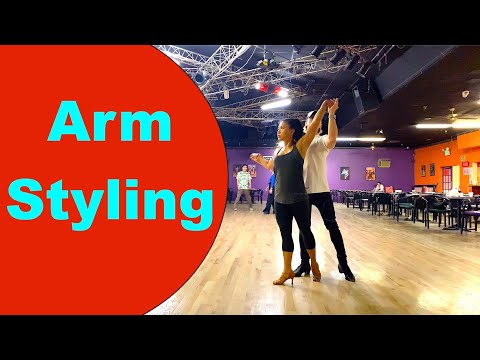
Posture & Bodyweight in Latin with Andrea Silvestri & Martina Varadi
Summary
In this instructional video, expert Latin dancers Andre Sylvestri and Martina V. break down the vital physical fundamentals of Latin dance, focusing on body weight and posture. They outline how to place body weight across three areas of the foot, establish strong left and right balance lines, and straighten the spine's natural curves from the ground up. Lastly, they explain how dancers can integrate these foundational elements to project height, width, and depth, ensuring a highly dynamic, continuous three-dimensional movement style which keeps the body of the dancer expressive and balanced.
Key Insights
Mastering the three zones of the foot is crucial for precise weight placement and balance control.
The human foot contains three key landing areas for body weight: the ball, the middle, and the heel. Dancers must constantly monitor which zone is supporting their weight. Practicing weight shifts without breaking alignment teaches the body how to anchor itself cleanly using the toes and feel when it is centered or leaning entirely on the heels.
A strong posture is developed by actively erasing the spine's natural curves from the bottom up.
To build a robust Latin posture, a dancer must straighten their upper and lower spinal curves. Adjustments must follow a ground-up order, beginning with the floor and feet, rising through the legs, stretching the lower back, and finally positioning the upper body through the rotation of the shoulder blades.
Constructing dual balance lines offers structural resistance against external destabilizing forces.
Dancers should identify two distinct vertical balance lines: left and right. Each line runs from the neck-shoulder transition point, down through the hip, pelvis, leg, and ankle. Establishing these pathways creates a highly centered body alignment that remains firm and resistant to disruptions from any direction.
The element of depth is the hardest to master but creates authentic three-dimensional dance presence.
While height and width are straightforward, creating depth demands an ongoing rotational twist around the spine. Dynamic Latin dancing requires that the body never looks flat or stationary; instead, continuous internal opposition is generated to maintain a lively, substance-filled presence on the floor.
Sections
The Mechanics of Body Weight on the Foot
The foot is divided into three distinct sections—the ball, middle, and heel—which dictate precise balance during Latin dancing movements.
The speakers introduce physical body weight as the weight of the dancer's own self, noting how imperative it is to master its placement on the feet. The foot splits into three critical sections: the ball of the foot, the middle of the foot, and the heel. To develop a feel for this structure, Andre recommends a simple, focused exercise where the dancer stands completely still and consciously shifts weight forward to the ball of the foot. In this forward position, the toes must actively seek contact with the floor, gripping it like a cat climbing on a wall. Next, the weight shifts back into the middle of the foot, where weight is distributed equally between the front and the back. During these shifts, the dancer should attempt to move as a single, unified piece with a fully aligned posture, keeping the shoulder, hip, and ankle in one vertical line before moving the weight onto the heel. On the heel, the toes should feel free enough to move gently, confirming that the heels are bearing the entire body pressure.
Weight transfer must primarily move forward and backward because the foot structure is naturally designed to support front-to-back movement.
The speakers emphasize that the body weight should strictly travel along a front-and-back axis during movement, rather than drifting side-to-side. Humans lack the physical support systems on the outer edges of the feet to manage sideways balances. Shaking or shifting weight to the sides ruins balance. Even in normal life and walking, movement flows naturally along a forward and backward course. Attempting to shift weight laterally leads to instability, which is why dancers must adhere firmly to a forward-backward line of weight flow.
Two vertical balance lines, left and right, run from the shoulder-neck transition through the hips down to the ankles.
Andre demonstrates the concept of left and right balance lines using Martina. These invisible vertical paths are mapped from the point where the neck transitions to the shoulder, running straight through the hips, pelvis, leg, and down into the ankle. Aligning the body along these pathways generates immense structural stability. Andre demonstrates this by trying to physically push Martina forward, back, and from side to side; because she is aligned along these balance lines, she remains stable and firmly anchored, highlighting the power of conscious alignment.
Principles of Latin Posture
Proper posture involves straightening the spine's natural upper and lower curves instead of puffing the chest or sticking out the buttocks.
The speakers warn against common posture mistakes, such as men over-exaggerating and puffing up their chests or women excessively sticking out their glutes. Humans naturally have two organic curves in their spine: one located in the lower lumbar back region, and another in the upper thoracic region. Rather than accentuating these, Latin dancers must focus on strengthening and straightening out these curves. Straightening these regions provides a clean, stable starting framework for all movements.
Straightening the lower curve requires tucking the seat bone underneath the body and stretching the lower back to create leg space.
To straighten the lower spinal curve, dancers must not squeeze their glutes. Rather, they should focus on creating a longer, stretched lower back, which provides the legs with more freedom to move. Dancers must tuck their seat bones underneath their pelvis, creating a counter-tension feel as if one hand is gently pushing the front of the pelvis in while another hand pulls the back out. This stretch creates space for the lower center and moves the body weight slightly toward the heels to secure the alignment.
Straightening the upper curve involves active rotational projection of the shoulder blades forward and diagonally rather than just squeezing them.
To manage the upper spinal curve, dancers must work deliberately with their shoulder blades. Simply squeezing the shoulder blades together and forcing them down creates a rigid, awkward look that Andre compares to a 'duck on a lake'. Instead, dancers must drop their shoulder blades and project them in a forward, diagonal, and under-rotated direction. Executing this correctly causes the chest bones and front collar area to lift naturally, creating a broad, poised upper body stance.
Posture must always be built from the floor upward, moving through the legs and core up to the upper chest area.
Martina presents the most crucial rule for a proper posture: never seek to define your posture from the top down. True body alignment must always grow sequentially from the floor, traveling up through the legs, into the lower core, and finally expanding through the upper back and chest. Grounding oneself first ensures that any further upper body shaping remains organically supported.
The Three Dimensions of Movement
Dancers must project their movement through three distinct physical dimensions: height, width, and the highly complex dimension of depth.
A well-aligned posture and precise weight placement together generate three-dimensional space: height, width, and depth. Working within all three planes prevents a flat performance. Of these dimensions, depth is the most challenging for dancers to develop. Creating depth requires consistent physical rotation around the vertical axis of the spine, preventing the dancers' bodies from ever appearing flat, stiff, or stationary.
Maintaining continuous opposition within the body ensures that Latin movements look substantive, dynamic, and never static or stiff.
Latin and ballroom dancing bodies are always working; they must never appear stopped or frozen. Dancers must rely on continuous opposition within their muscles to create movement. Proper posture and foot-to-foot weight transfers provide the foundation. Once the base posture and weight distribution are solid, dancers can build the physical opposition needed to generate highly visual, three-dimensional shapes on the floor.
Ask a Question
*Uses 1 Wisdom coin from your coin balance