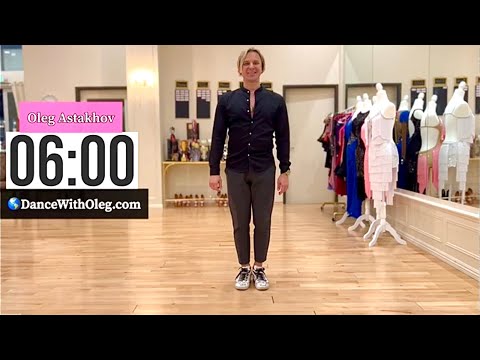
International Rumba- Zoom class notes - basic, spot turn, and partnering
Summary
This instructional dance video breaks down a versatile Latin routine featuring side basics, spot turns, cucarachas, and back-up steps. The instructors demonstrate the sequence step-by-step with precise rhythmic counts, emphasizing partnership communication, correct arm styling, and optimal frame maintenance. They explain how to build upon these foundational patterns by adding quarter turns, delayed underarm turns, and hand-to-hand actions. Finally, they showcase how these core concepts seamlessly translate to other popular Latin dance styles, such as Bolero, Salsa, and Cha-Cha.
Key Insights
The importance of proactive frame preparation during turn transitions
During underarm and delayed turns, the leader must proactively prepare and position their arms in advance. This ensures the follower can be safely and securely caught directly back into a closed frame on the count of two, avoiding a sloppy transition and maintaining partnership alignment.
Establishing connection and distance during Cucaracha steps
Cucarachas require the dancers to step further apart, creating deliberate physical space. To maintain connection, the leader must actively reach and connect hands with the follower, utilizing this physical touch to communicate the pivot and smoothly transition back into the closed hold on two three four one.
Sections
Dance Routine Walkthrough and Basics
Execution of the side basic steps
The routine begins with four sets of side basics, starting with a count that transitions from dancing on two three, going for one, performing a check step on three, and moving to the side on four one.
Performing spot turns with sharp counts
The spot turns require dancers to step across, initiating the rotation on the count of three. The cadence goes side four one, two three and four one, two three four one, and two three, designed to keep rotations tight and controlled.
Executing cucarachas with hand releases and open styling
Cucarachas are executed on counts of two, three, and a close change on four one, leading into two three four one. The dancers release hands on two three four one, step back on two three to the side, and flare their arms open.
Walking steps and progressive backups
The back-up sequence involves moving backward on two three, executing a close or change on one, followed by walking forward on two three and four. This flows into a turning walk and a rock back on two three four one.
Styling, Arm Positioning, and Partner Connection
Re-establishing frame with float-back arm styling
During spot turns, instructors emphasize taking the arms out on two three four and letting them float back naturally. The gentleman must pre-position his arm frame to welcome the lady back instantly after her turn.
Creating space and partner communication in Cucarachas
When dancing Cucarachas, partners naturally drift further apart. The leader is instructed to actively reach out and clasp the follower's hand, establishing a physical reference point that facilitates the subsequent pivot.
Driving back to a stable closed frame
When executing rock steps (counted as two three four one), both partners must drive back into the closed hold from different directions. Maintaining frame integrity ensures balance and postural alignment throughout.
Transitions and Pattern Variations
Incorporating quarter turns for redirection
Quarter turns can be integrated straight into the basic steps. This variation allows the couple to turn their basic pattern by ninety degrees, making it highly useful for navigating the dance floor.
The underarm turn with delayed rotation
The underarm turn is performed on counts four one and two three. It features a delayed rotation where the leader's arms must be stationary and ready to catch the follower in frame on the count of two as she completes the turn.
Transitioning to hand-to-hand movements
From the underarm turn, dancers can transition into open hand-to-hand styling on counts of two three four and two three. This adds spatial variety before returning to the standard closed frame.
Adaptation to Other Dance Styles
Applying the patterns to Bolero
The steps practiced can be easily adapted to Bolero, which shares the same basic step shape, spot turns, and underarm turns. The primary differentiator is the unique rise-and-fall action characteristic of Bolero styling.
Cross-compatibility with Cha-Cha and Salsa
The core figures and partner safety principles (like catching on two) are fully compatible with Salsa and Cha-Cha, allowing social dancers to apply this single sequence across multiple genres.
Ask a Question
*Uses 1 Wisdom coin from your coin balance