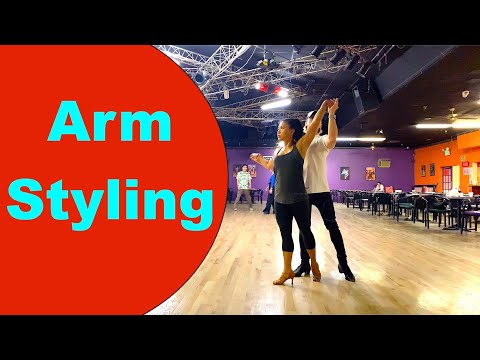
How to Rumba Walk (forward) & Spiral Turn (Rumba Dance Tutorials) Kat Fedosova | MihranTV
Summary
This tutorial explains how to perform a Rumba walk with a spiral turn, a move in ballroom dancing. It breaks down the hip action, timing, and execution of both the basic Rumba walk and the more advanced spiral turn. Key elements include hip elevation, weight transfer, creating separation between the upper body and hips for momentum, and spotting to maintain balance during the turn. The lesson emphasizes practicing slowly and mastering each component before combining them.
Sections
Rumba Walk Hip Action
Collect your back foot to your front foot, focusing on hip elevation.
Starting with the right foot back, collect it to the left foot. As the foot is collected, the left hip moves up. As the foot moves back, the right hip moves up. This creates a pendulum action with the hips: left hip up, right hip up, repeating.
Execute the hip action while stepping forward, maintaining hip elevation.
Start with the right foot back, move through a neutral position with feet together. Continue the right foot forward, with the left hip continuing to move upwards. As the left foot collects to the right, the right hip moves up. As the left foot steps forward, the left hip continues to move upwards, remaining elevated.
Hip movement is diagonal, moving back and up.
When stepping forward, the hip moves diagonally back and up. The hip motion contributes to the progressive forward movement of the dancer.
Rumba Walk Timing and Steps
Rumba walk uses four counts with three steps, with the third step being slower.
In Rumba, there are four counts but only three steps. This means one count goes into each of the first two steps, and two counts go into the third, longer step. The timing is quick, quick, slow.
The third, slow step is an opportunity to extend and showcase hip action and posture.
The slow count (the third step) is crucial for extending the back leg, showcasing the hip action, and highlighting posture. This step defines the 'flavor' of Rumba, contrasting fast steps with an elegant, slow one.
The 'four-one' count is when you extend and showcase the hip action and posture.
The timing 'four-one' is when the dancer should extend their leg as much as possible, pushing off the back foot and using hip rotation to emphasize the movement and posture. This involves a longer, more expressive third step.
Rotate hips to create extra twist and move hip away, twisting off the floor.
During the 'four-one' step, the dancer should twist off the floor, which helps move the hip away and change direction. Pushing off the back foot and using rotation are key. This creates a 'crunch' in the side from moving and rotating the hip away from the upper body.
Hip rotation increases flexibility and range of motion with practice.
Practicing increased hip rotation and squeezing the hip more each time helps build flexibility. Dancers should push themselves to their limits to improve their range of movement.
Spiral Turn Technique
The spiral turn is an advanced move fitting into the two-count 'four-one' step.
Instead of just extending on the 'four-one' step, a spiral turn can be added. This requires significant technique and balance, fitting into the two counts allocated for that step.
Create momentum for a fast spiral by separating hips and upper body.
To spiral, step forward on the left foot, extend the right hip, and rotate it away while keeping the upper body forward. This position helps create momentum. Hold weight on the back foot to facilitate a fast spiral rhythm and create opposition between the right and left foot by separating the hip and rib cage.
During the spiral, keep the spine straight and the back foot engaged with the floor.
As you spiral, maintain a straight spine and keep the back foot pivoting on the floor. The standing leg supports the rotation. The spiral happens around the standing leg. Finish by settling the hip of the standing leg to continue moving forward.
Spiral turns require maintaining posture, spotting forward, and avoiding dropping the upper body.
Keep the posture straight, spine long, shoulders down, and neckline elongated during the spiral. Focus eyes forward ('spotting') to maintain balance and prevent dizziness. Do not let the upper body drop.
The spiral turn relies on creating tension between the upper body and hips for power.
Sufficient separation and tension between the upper body and the hip are crucial for a sharp and quick spiral. This tension provides the power for the rotation.
Practice the spiral by creating maximum separation and tension over eight counts before turning.
An exercise for the spiral involves spending eight counts creating maximum separation and tension between the upper body and hips. Then, execute the spiral. This builds the necessary power and control for a sharp turn.
Spotting forward is critical for balance and sharp rotation during the spiral turn.
Keeping your eyes fixed on a forward spot (spotting) is essential for maintaining balance and achieving a sharp, quick rotation. This helps focus on the center and spine, ensuring a balanced finish.
Advanced dancers can attempt a double spiral turn.
Once proficient, dancers can try executing a double spiral turn, which involves completing two full rotations within the allotted counts.
Combining Rumba Walk and Spiral Turn
Practice Rumba walk and spiral turn separately before combining them.
It is recommended to master the basic Rumba walk and the spiral turn individually before attempting to combine them. This ensures that each component is well-executed.
Moving hips smoothly from side to side creates a flowing dance.
The movement of hips from side to side should be smooth and continuous, like a conversation, connecting one side to another. Avoid abrupt stops. This fluidity is key to the Rumba's character.
The spiral turn adds a challenging but exciting element to the Rumba walk.
Integrating the spiral turn into the Rumba walk makes the dance more dynamic and exciting, but it significantly increases the technical difficulty. Practice is required to execute it smoothly with music.
Ask a Question
*Uses 1 Wisdom coin from your coin balance