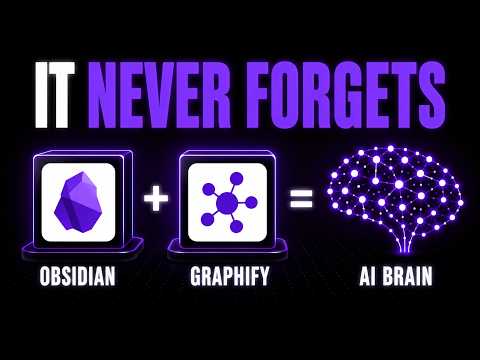
Build This ONCE. Any AI You Use Will Get Smarter Forever.
Summary
The video introduces the concept of the 'friction tax' paid when using AI, characterized by repetitive explanations and tool switching. It proposes an 'information hierarchy' as the solution. This structured system, built once, allows any AI tool to understand a user's business, voice, and specific project needs, thus eliminating repetitive setup and improving AI efficiency. The hierarchy consists of a business folder with core information files and project-specific folders with instructions, voice guidelines, references, examples, and notes.
Key Insights
The problem with AI use is not the prompt or the tool, but the AI's zero-start knowledge.
A better prompt or a new tool won't solve the core issue because AI tools begin with no prior knowledge of the user or their context. The AI starts from zero every single time, leading to inefficiency and frustration.
The core AI investment is the information hierarchy, not the transient AI agents.
Instead of building agents, the focus should be on building the information they read. The AI agent itself is disposable and can be switched out (e.g., Claude, ChatGPT, Gemini). The information hierarchy is the persistent asset that stays relevant and allows any AI to function effectively by already knowing the user's context and voice.
The information hierarchy allows any AI to perform tasks accurately based on the user's context.
Once set up, the hierarchy enables any AI (e.g., Claude, Gemini) to understand the user's business, voice, and project requirements without repeated explanations. Simply pointing the AI at the hierarchy and assigning a task yields relevant and personalized results.
The information hierarchy represents a durable AI investment, independent of specific AI tools.
The hierarchy is the lasting asset, while AI models and tools are disposable and constantly evolving. By centralizing user-specific knowledge, it ensures that efficiency gains persist even as AI technology changes, making it the only AI investment that doesn't expire.
Sections
The Friction Tax of Using AI
Users pay a 'friction tax' when using AI due to repetitive setup and explanations.
Every time you sit down to use AI, you essentially start from zero. This involves re-explaining who you are, your business, and your preferences for writing. The output is often almost correct, requiring significant time to fix, and this process repeats daily. Even if a tool has memory, switching tools means starting from scratch, losing all accumulated context.
The problem with AI use is not the prompt or the tool, but the AI's zero-start knowledge.
A better prompt or a new tool won't solve the core issue because AI tools begin with no prior knowledge of the user or their context. The AI starts from zero every single time, leading to inefficiency and frustration.
The 'friction tax' has three main components.
The friction tax includes: 1. Duct-taping AI together: Stringing various tools and prompts with copy-pasting and hoping for the best. 2. Re-explaining yourself: Each new chat starts from zero; the AI doesn't know your identity, business, writing style, or ideal customer profile. Memory is tool-locked. 3. Subscription roulette: Paying for numerous tools without certainty of their necessity or usage, driven by constant new tool recommendations.
The Information Hierarchy Solution
The 'information hierarchy' is a structured system to provide AI with necessary context.
This hierarchy is a one-time build that makes any AI used 'smarter' by providing it with consistent, organized information about the user and their specific needs. It solves the friction tax by eliminating the need for repeated explanations.
AI agents are defined by models using tools in a loop, but their effectiveness depends on readable information.
An AI agent is an AI model that uses tools (actions like reading files, sending emails, searching the web) in a loop to complete a task. The key differentiator between agents is not the AI model itself, but the quality and clarity of the information it can access and the description of the job.
Effective AI use requires providing context and information like onboarding a new human team member.
When bringing a new person onto a team, you provide context about the business, show examples of good work, and grant access to relevant information. This is currently missing in AI interactions, leading to generic or inaccurate outputs. The fix is writing your business down once in a way any AI can read.
Organizing information like a textbook improves AI learning and efficiency.
Structuring information into chapters, sections, and headings, similar to a textbook with a table of contents and index, is how humans learn best and how AI learns best. This organization makes the information accessible and understandable for AI.
The core AI investment is the information hierarchy, not the transient AI agents.
Instead of building agents, the focus should be on building the information they read. The AI agent itself is disposable and can be switched out (e.g., Claude, ChatGPT, Gemini). The information hierarchy is the persistent asset that stays relevant and allows any AI to function effectively by already knowing the user's context and voice.
Structure of the Information Hierarchy
The hierarchy has two main tiers: a business folder and project folders.
The structure consists of a top-level 'business folder' containing core business information and multiple nested 'project folders' for specific undertakings. This organization ensures all relevant information is categorized and easily retrievable.
The 'business folder' contains four essential files detailing fundamental business information.
This top tier includes: 1. 'About Me': Personal details, name, and a one-line professional description. 2. 'About My Business': What is sold, who is served, and unique selling propositions. 3. 'About My Voice': Crucial for high leverage; defines writing style, tone, preferred words, and words to avoid, using examples like emails or blog posts. 4. 'My Offers': Current products/services with pricing details, requiring succinct yet detailed information.
The 'About My Voice' file is critical for establishing a consistent brand persona.
This file is the highest leverage of the four business files. It dictates the writing style and tone of voice, including specific words and phrases to use or avoid. It can be informed by spoken word transcripts if writing style matches speaking, but typically requires written examples like emails or newsletters.
Each 'project folder' includes five consistent subfolders for detailed project management.
Every project (e.g., newsletter, client work, YouTube) has its own folder with five standard subfolders: 'Instructions' (master directives, project goals, output examples, what to avoid, pointers to other folders), 'Voice' (specific voice guidelines for the project, vital for client work), 'References' (documents for the AI to read, like research or transcripts), 'Examples' (samples of good output), and 'Notes' (ongoing updates and feedback for AI learning).
The 'Notes' subfolder allows AI to learn from ongoing project feedback and performance.
This subfolder is for dynamic updates. For instance, noting that a specific approach in a newsletter yielded a high open rate. This feedback loop allows the AI to continuously learn and adapt, improving its outputs over time based on real-world results.
Implementing the Information Hierarchy
AI tools like Claude Co-work can automate the creation of the hierarchy structure.
Users don't need to manually create all folders and files. Tools such as Claude Co-work can generate the entire folder structure and empty files based on simple voice commands or prompts, significantly speeding up the setup process.
AI can interview users or organize existing files to populate the hierarchy.
For filling in the files, AI can either interview the user to gather information or automatically organize pre-existing documents into the correct hierarchy structure. This reduces the need for manual data entry and tedious file management.
The information hierarchy allows any AI to perform tasks accurately based on the user's context.
Once set up, the hierarchy enables any AI (e.g., Claude, Gemini) to understand the user's business, voice, and project requirements without repeated explanations. Simply pointing the AI at the hierarchy and assigning a task yields relevant and personalized results.
The information hierarchy represents a durable AI investment, independent of specific AI tools.
The hierarchy is the lasting asset, while AI models and tools are disposable and constantly evolving. By centralizing user-specific knowledge, it ensures that efficiency gains persist even as AI technology changes, making it the only AI investment that doesn't expire.
Ask a Question
*Uses 1 Wisdom coin from your coin balance