Unlocking Your Intuition: How to Solve Hard Problems Easily
Summary
This video explains the concept of intuition as a fast, unconscious part of the brain that recognizes patterns and offers solutions based on past experiences. It highlights how developing intuition is crucial for problem-solving in various fields, not just programming. The speaker shares a personal strategy for rapid intuition development through problem and solution component mapping, emphasizing that intuition should complement, not replace, logical reasoning and rigorous practice.
Key Insights
Intuition is a fast, unconscious pattern-matching system based on past knowledge.
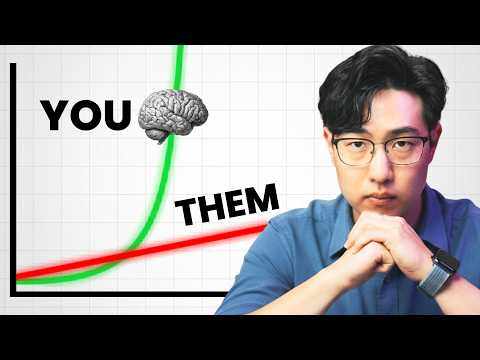
Intuition is described as the 'fast side' of the brain, operating unconsciously and instantly by drawing on learned patterns and past experiences to recognize solutions to familiar problems. It's like a sixth sense that categorizes new problems based on similar ones encountered before, allowing for rapid recognition and solution generation. The more knowledge absorbed, the more accurate this 'fast brain' becomes.
Developing intuition requires deliberate practice and structured learning.
The speaker proposes a strategy where one deeply analyzes problem and solution components, creating mental maps and associations. This involves breaking down problems and solutions into memorable parts, understanding the 'why' behind associations, and actively creating mental mappings. While solving problems normally improves logic, this 'fast strategy' of mapping components directly enhances intuition, offering a trade-off in learning depth versus speed of intuition development.
Sections
Understanding Intuition
Intuition is an unconscious, lightning-fast problem-solving mechanism.
Intuition is a powerful intellectual function that operates unconsciously, brewing up solutions almost like magic. It's characterized by the ability to instantly recognize solutions to familiar problems, akin to second nature, and can be applied to various domains like programming, math, and real-life challenges.
The brain has a fast side (intuition) and a slow side (reasoning).
The brain is divided into a slow side, which involves conscious effort, processing, and reasoning, and a fast side that is fuel-based and unconscious. Intuition resides in this fast side, relying entirely on past knowledge and current situation due to its speed, and becoming more accurate with increased knowledge absorption.
Intuition acts as a pattern recognition system, asking if past solutions will work.
At its core, intuition checks if a previously successful approach will apply to the current problem, coming as a gut feeling. It works by categorizing problems based on similar elements encountered before, enabling the recognition of patterns and the assembly of solutions.
Distinction between intuition and insight.
Intuition is part of the fast brain, offering instant recognition based on past knowledge. Insight, however, is associated with the slow brain, involving deep reflective thought that generates new, novel solutions rather than relying on established patterns. It's described as finding useful ideas within the random noise of thoughts.
Benefits and Usage of Intuition
Developing intuition offers significant advantages in problem-solving speed.
Intuition is crucial for time-based problems, providing the fastest brain process. Strong intuition leads to correct initial thoughts and guides subsequent steps, preventing conflicts with the slow brain and ensuring more accurate progress through complex problems.
Intuition should be used in conjunction with, not as a replacement for, reasoning.
Intuition generates shallow ideas or initial steps; these must be expanded into full solutions using the slow brain and reasoning. The fast and slow brains should work together, with intuition providing direction and reasoning filling in the details.
It's vital to verify intuition, as it can be incorrect.
Intuition can sometimes point in the wrong direction, and it's difficult to ignore. Verifying intuition with actual justification, proof, or small example cases is essential. Strong logical thinking and reasoning skills help in identifying and overcoming misleading intuitions, allowing for a balance between intuitive and purely logical approaches.
Intuition is primarily based on past information, less effective for entirely new problems.
Intuition excels at recognizing familiar elements within problems. For completely novel challenges, logic or insight may be more beneficial than intuition, as it heavily relies on prior experience and learned patterns.
A Strategy for Enhancing Intuition
The strategy involves creating mental mappings between problem and solution components.
The core strategy is to break down problems and solutions into memorable pieces (problem components and solution ideas) and create mental associations between them. This process mimics how intuition works by establishing direct links between encountered problem elements and appropriate solution strategies.
Understanding the 'why' behind associations enhances intuition accuracy.
Understanding why specific component associations work helps the intuition grasp relevance, improving its accuracy. It also helps identify when new associations are needed if current ones don't justify a solution.
Actively solving problems or deeply engaging with solutions aids memory and intuition.
While the speaker used a shortcut (reading solutions quickly), actively solving problems or spending significant time with solutions leads to better memory, deeper understanding, and more accurate intuition because the brain better understands the underlying reasoning and associations.
Balancing intuition training with traditional problem-solving practice is key.
A pure mental mapping strategy can lead to being lost in complex problems where slow-brain reasoning is dominant. Normal practice improves logic, while the mapping strategy boosts intuition. Both are valuable, and individuals can choose their preferred balance or combine both approaches.
Explicit testing and challenging oneself are important for intuition development.
Testing intuition by guessing high-level general ideas for problems and verifying with proofs or full solutions helps identify errors and learn. Challenging oneself with difficult problems is crucial, as ease doesn't foster significant growth, although practicing easier problems can build speed.
Nurture, passion, and belief in one's ability are critical for improvement.
Intelligence and intuition are largely shaped by nurture (experience, education, exposure to challenges) rather than solely genetics. Passion is a key motivator for effective learning and improvement. Believing that one's intelligence is controllable and can be improved through effort is essential for taking action and achieving potential.
Acknowledge contradictions and emphasize good practice.
While proposing a new strategy, the speaker acknowledges apparent contradictions with past advice, clarifying that good practice remains fundamental. The intuition-focused strategy is presented as an enhancement to, not a replacement for, solid practice, aiming for specialized intuition development when combined effectively.
Ask a Question
*Uses 1 Wisdom coin from your coin balance