Think In Systems: The Skill Most People Never Learn (Full Course)
Summary
This course introduces systems thinking as a method to understand and resolve recurring problems by identifying the underlying structures. It teaches readers to view problems not as isolated events but as outputs of interconnected systems composed of elements, interconnections, and purpose. The course equips viewers with tools to map these structures using causal loop diagrams, understand reinforcing and balancing loops, and apply concepts like stocks, flows, valves, and buffers. It emphasizes shifting focus from symptoms to structural changes, understanding delays, avoiding overcorrection, and identifying leverage points for lasting solutions.
Key Insights
The Iceberg model differentiates events, patterns, and structures.
Problems are viewed like icebergs: events (a single occurrence) are the visible tip, patterns are repeating events, and structures are the underlying arrangement of incentives, information, and habits that generate the pattern. Shifting focus from events to structures allows for addressing the root cause rather than symptom management. For example, a failed diet plan's structure might be aligning a high-motivation January plan with a low-motivation February reality.
Reinforcing loops amplify growth or decay.
An 'R' loop signifies a cycle where increases lead to further increases (or decreases to further decreases), creating snowball effects like skill development or debt accumulation. These loops explain why small advantages or disadvantages can lead to vastly different outcomes over time. Interventions should focus on nudging these loops in the desired direction.
Balancing loops defend a specific set point.
A 'B' loop seeks to maintain a target level, like a thermostat. Examples include dieting (body defending a weight set point) or spending habits. Instead of fighting a balancing loop with willpower, the effective strategy is to change the set point or the environment that defines it.
Loop dominance shifts over time, influencing strategy.
Early in a situation, a reinforcing loop often dominates, driving growth. As the system matures, a balancing loop emerges to constrain growth. Recognizing this handoff is crucial; strategies that worked during the reinforcing phase (feeding the engine) become ineffective when a balancing loop dominates (tending the constraint), leading to burnout.
The Valve Rule: Act on flows, not stocks.
You cannot directly change a stock (e.g., 'be fit'). You can only influence its flows by adjusting the valves controlling them (e.g., 'go for a walk'). Effective plans translate wishes into specific valve settings (rates with numbers and days).
Behavior changes when the signals, delays, and incentives presented to individuals change.
People act rationally based on local information. Instead of assuming personal failure, focus on redesigning the system's structure to provide different signals and incentives, which will naturally alter behavior without requiring a 'character transplant'.
Sections
Introduction to Systems Thinking
Systems thinking views recurring problems as outputs of underlying structures.
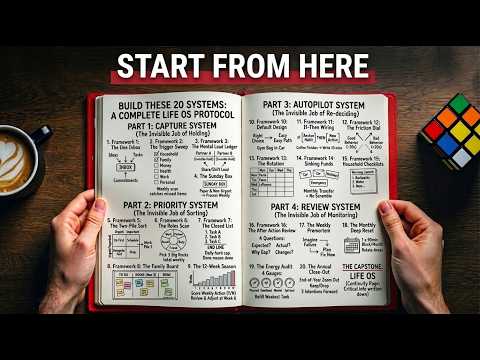
A problem that keeps returning is being produced by a structure, which can be broken down into four key components: a draining tank, a draining loop, a hidden delay, and an ineffective lever. The course offers 20 tools to analyze any persistent problem and identify the correct lever to pull. Viewers are encouraged to hold three personal recurring problems in mind throughout the course.
The System Test distinguishes systems from simple heaps.
A system consists of elements, interconnections, and a purpose, where parts feed each other to create emergent behavior. To identify a system, list its parts, draw their connections, and name what it reliably produces, which is its true purpose. For example, a manager's planning ritual might reliably produce guilt, not a focused week, making guilt its actual output.
The Iceberg model differentiates events, patterns, and structures.
Problems are viewed like icebergs: events (a single occurrence) are the visible tip, patterns are repeating events, and structures are the underlying arrangement of incentives, information, and habits that generate the pattern. Shifting focus from events to structures allows for addressing the root cause rather than symptom management. For example, a failed diet plan's structure might be aligning a high-motivation January plan with a low-motivation February reality.
Seeing the Structure: Notation and Loops
Causal loop diagrams visualize system structures using variables and links.
Variables are nouns that can change level (e.g., stress, savings). Links are arrows with plus (+) for same-direction influence or minus (-) for opposite-direction influence. Reading links aloud as sentences helps verify their accuracy. The diagrams capture what *does* happen, not what *should* happen.
Reinforcing loops amplify growth or decay.
An 'R' loop signifies a cycle where increases lead to further increases (or decreases to further decreases), creating snowball effects like skill development or debt accumulation. These loops explain why small advantages or disadvantages can lead to vastly different outcomes over time. Interventions should focus on nudging these loops in the desired direction.
Balancing loops defend a specific set point.
A 'B' loop seeks to maintain a target level, like a thermostat. Examples include dieting (body defending a weight set point) or spending habits. Instead of fighting a balancing loop with willpower, the effective strategy is to change the set point or the environment that defines it.
Loop dominance shifts over time, influencing strategy.
Early in a situation, a reinforcing loop often dominates, driving growth. As the system matures, a balancing loop emerges to constrain growth. Recognizing this handoff is crucial; strategies that worked during the reinforcing phase (feeding the engine) become ineffective when a balancing loop dominates (tending the constraint), leading to burnout.
The Plumbing: Stocks, Flows, and Valves
Stocks and flows model system levels and their changes over time.
A stock is an amount that can be measured at a point in time (e.g., energy, trust), while flows are the rates that increase or decrease the stock (e.g., sleep/food for energy, effort/worry for draining it). The level of a stock is the history of its flows. Real change is often slow due to flow limitations, and stability is achieved when inflow equals outflow.
The Valve Rule: Act on flows, not stocks.
You cannot directly change a stock (e.g., 'be fit'). You can only influence its flows by adjusting the valves controlling them (e.g., 'go for a walk'). Effective plans translate wishes into specific valve settings (rates with numbers and days).
Buffers absorb shocks and prevent crises.
A buffer is a stock held above immediate need (e.g., money, sleep) that absorbs unexpected events. Running lean, without buffers, turns small shocks into major crises. Prioritizing buffer refills when low is essential for resilience.
Judge change by slope (rate), not snapshot (level).
A single measurement (snapshot) can be misleading. True progress is indicated by the rate of change (slope) between two or more measurements. Focusing on the trend prevents quitting prematurely when a snapshot looks poor but the trajectory is positive.
Time and Its Illusions
Delays separate cause and effect, masking accountability.
Systems often have time gaps between actions and consequences. This delay obscures traceability, so bad causes escape blame and good causes get abandoned before payoff. Setting realistic payoff dates and tracking effort separately from results is crucial.
Overcorrection arises from delayed signals and impatient adjustments.
Responding to delayed information with large, impatient corrections can lead to oscillation, swinging between extremes. The solution is to 'turn down the gain': make smaller corrections and wait for the delay to pass before adjusting again.
The Bullwhip Effect amplifies small wobbles upstream into large swings downstream.
In interconnected systems, minor variations at one end can become amplified through stacked delays and padding as they move along the chain. Managing the downstream symptom is less effective than smoothing the small, boring input at the source.
Archetypal Problem Shapes and Solutions
Shifting the Burden: Quick fixes undermine real solutions.
This occurs when a quick-acting symptom solution (e.g., caffeine for fatigue) temporarily alleviates the problem, reducing the impetus to address the slower, root cause (e.g., sleep hygiene). This creates dependence on the quick fix and weakens the system's ability to solve itself. Cap the quick fix and schedule the slow fix.
Fixes That Fail: Solutions create their own demand.
A fix works immediately but carries a hidden cost delivered later, which exacerbates the original problem. For example, all-nighters to meet deadlines lead to degraded workdays that incubate future crises. The key is to truly price the boomerang effect of any repeated fix.
Limits to Growth: Progress stalls when constraints are hit.
Efforts to grow often hit environmental limits (e.g., resource scarcity, attention deficit). Pushing harder on the 'engine' of growth when a 'brake' (balancing loop) is engaged only deepens the plateau or burnout. Identify and address the binding constraint directly.
Tragedy of the Commons: Shared resources deplete from reasonable individual use.
Shared stocks (e.g., office kitchen cleanliness, marital goodwill) degrade when many individuals make small, seemingly reasonable withdrawals without a system for collective replenishment. Making the level visible and establishing shared refill rules is essential.
The Cynefin Framework sorts problems into domains for appropriate action.
Problems fall into five categories: Clear (obvious cause/effect, use known solutions), Complicated (knowable answer, use expert analysis), Complex (cause/effect visible only in hindsight, use small experiments), Crisis (act immediately to stabilize), and Confused (the default state). Applying the wrong method to the wrong domain is a common failure.
Where to Actually Push: Leverage and Transition
The Leverage Ladder ranks interventions from weak to strong.
Interventions increase in effectiveness from adjusting quantities (Rung 1), changing physical structure (Rung 2), making information flows visible (Rung 3), changing system goals/rules (Rung 4), to transforming underlying beliefs/stories (Rung 5). Higher rungs yield greater results for less effort.
The Niche Strategy facilitates change through protected experimentation.
Large changes succeed not by assaulting the dominant 'regime' directly, but by nurturing fragile new practices within 'niches' until surrounding 'landscape' shifts allow them to mature and take over. This involves small, low-stakes experiments shielded from immediate competition.
A four-step protocol synthesizes systems thinking tools for practical problem-solving.
The protocol involves: 1. Naming the straining stock. 2. Tracing the draining loop. 3. Identifying the fooling delay. 4. Climbing one rung up the leverage ladder for intervention, focusing on structure or information rather than symptom adjustment.
Behavior changes when the signals, delays, and incentives presented to individuals change.
People act rationally based on local information. Instead of assuming personal failure, focus on redesigning the system's structure to provide different signals and incentives, which will naturally alter behavior without requiring a 'character transplant'.
Ask a Question
*Uses 1 Wisdom coin from your coin balance