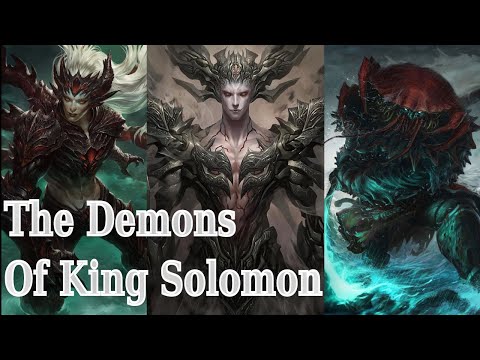
The History of Demons
Summary
The video traces the historical evolution of the concept of 'demon', starting from the ancient Greek 'daimon' which represented a broad category of spiritual beings, often intermediary and morally ambiguous. It explains how Christian theology, influenced by Jewish apocalyptic literature and the Septuagint translation, gradually polarized this concept into exclusively evil entities, contrasting them with angels and ultimately shaping the modern stereotype of demons as purely malevolent forces.
Key Insights
Moral ambiguity was a key characteristic of Greek and Roman daimons.
A hallmark of daimons in Greek and Roman religion was their moral ambiguity. They were seen as in-between creatures that could be feared or employed for one's benefit, not fitting neatly into good or evil categories.
Christianity solidified the concept of demons as purely evil adversaries.
The Gospels and the Apostle Paul consistently portrayed demons as unequivocally evil beings. Paul equates pagan sacrifices with offerings to demons, and the Gospels depict Jesus's exorcisms as defeats of malevolent forces. This contrasted sharply with the ambiguous nature of Greek daimons.
Christianity created a polarized supernatural cosmos of demons versus Christ.
As scholar David Frankfurter notes, Christianity established a sharply polarized supernatural worldview, creating an unambiguous division between demons and Christ, eliminating the moral ambiguity that characterized earlier conceptions of daimons.
Sections
The Ancient Greek and Roman Concept of Daimon
Modern demon stereotypes originate from Christian interpretations developed over 2,000 years.
The prevalent modern stereotype of demons includes red eyes, horns, fangs, and fire, which are largely products of Christian ideas developed over the past two millennia.
Demons in the New Testament are cast as Jesus' adversaries and foot soldiers of Satan.
In the New Testament Gospels, demons are presented as the primary adversaries of Jesus, who casts them out of people. In the Book of Revelation, they are depicted as the foot soldiers of Satan, cast into the abyss at the end of times.
Early Christianity equated pagan gods with demons.
As Christianity developed in the late Roman period, demons were increasingly equated with pagan gods, such as Zeus and Aphrodite, labeling them as demons.
Ancient Greek 'daimon' referred to a wide spectrum of spiritual beings between humans and gods.
The Greek word 'daimon' originally referred to a wide range of spiritual beings, not necessarily evil. Homer and Hesiod even referred to Olympian gods like Aphrodite as daimons. Generally, it encompassed anything between humans and gods.
Plato and Apuleius described daimons as intermediary beings facilitating communication and possessing magical powers.
Plato, in 'The Symposium', described daimons as intermediary beings that shuttle messages between gods and humans, controlling magical and astrological powers, including priestly rites, sacrifices, spells, and divination. Roman philosopher Apuleius echoed this, placing these 'divine middle powers' in the air between the ether and earth, influencing divination, inspiring prophets, causing lightning, and enabling fortune-telling.
Daimons occupied a power level between humans and gods but were not considered divine.
Plato and Apuleius agreed that daimons lived conceptually and by power level between humans and gods. They were more extraordinary than humans but not powerful or divine enough to be called gods. Plato, for instance, considered Eros a daemon, not a god.
The term 'daimon' encompassed various entities, from nymphs to souls of the dead.
The term 'daimon' covered a taxonomy of near-god beings, including nymphs and demigods, as well as intermediary divine powers. Crucially, it could also refer to the souls of the dead, including heroes and warriors, often invoked in Greek magical spells.
Ancient texts invoked corpse daemons for assistance, showing their morally ambiguous nature.
Greek magical spells, found in texts like the Greek Magical Papyri, invoked 'daemons of the dead' or 'corpse daemons' for help, such as in an erotic spell to make someone fall in love. This indicates that, while potentially spooky, these daemons were not inherently evil and could be commanded for benefit.
Daimons could perform supernatural feats, suggesting a helpful, albeit spooky, role.
Some Greek magical spells describe daemons as capable of freezing rivers to allow passage or other helpful, albeit extraordinary, feats, further illustrating their utility and ambiguous moral standing.
An internal 'daimon' could represent a spark of divinity or cognitive element within a person.
A less common but significant concept saw 'daimon' referring to an internal spiritual or cognitive element within a human. Socrates, in his defense (Apology), described an internal 'daimon' that guided him. Some spells claimed one could converse with their own 'daimon'.
Moral ambiguity was a key characteristic of Greek and Roman daimons.
A hallmark of daimons in Greek and Roman religion was their moral ambiguity. They were seen as in-between creatures that could be feared or employed for one's benefit, not fitting neatly into good or evil categories.
The Shift Towards Malevolent Demons: Jewish and Christian Influences
Jewish translation of the Hebrew Bible (Septuagint) began associating 'daimon' with evil concepts.
The Greek translation of the Hebrew Bible, the Septuagint, used the word 'daimon' to translate Hebrew terms for 'idol' and 'gods of other nations' (e.g., Psalm 96:5). This created an association between 'daimon' and pagan deities, leading Jewish writers to label pagan gods as evil daimons.
The Septuagint also translated 'disease' as 'daimonia', reinforcing negative connotations.
Furthermore, the Septuagint translated the Hebrew word for 'disease' as 'daimonia'. This usage unambiguously linked the term with negative and harmful entities, distinct from its earlier neutral or positive connotations.
Jewish apocalyptic literature described evil spirits and fallen angels without calling them 'daimones'.
During the Hellenistic period, Jewish apocalyptic literature like the Book of Enoch detailed rebellious angels (Watchers) influencing humans with forbidden knowledge and fathering giants. The Dead Sea Scrolls mentioned 'impure spirits' or 'evil angels'. While not explicitly called 'daimones', these texts laid groundwork for the concept of fallen, malevolent supernatural beings.
Christianity solidified the concept of demons as purely evil adversaries.
The Gospels and the Apostle Paul consistently portrayed demons as unequivocally evil beings. Paul equates pagan sacrifices with offerings to demons, and the Gospels depict Jesus's exorcisms as defeats of malevolent forces. This contrasted sharply with the ambiguous nature of Greek daimons.
Christianity created a polarized supernatural cosmos of demons versus Christ.
As scholar David Frankfurter notes, Christianity established a sharply polarized supernatural worldview, creating an unambiguous division between demons and Christ, eliminating the moral ambiguity that characterized earlier conceptions of daimons.
Early Christian magical practices focused on defense against explicitly malevolent demons.
Many early Christian magical spells and amulets, dating from the 300s CE, were created specifically for protection against demons, referred to as male and female, and various disturbances. The existence of expensive protective amulets indicates a strong perceived threat from these entities.
The modern concept of demons is a product of layered historical and cultural influences.
Our contemporary understanding of demons results from a complex historical layering: Christian theology shaped by Jewish apocalyptic traditions, which were themselves influenced by ancient Greek and Roman concepts of daimones. This highlights the importance of studying ancient texts within their original cultural contexts to understand how meanings evolve.
Ask a Question
*Uses 1 Wisdom coin from your coin balance