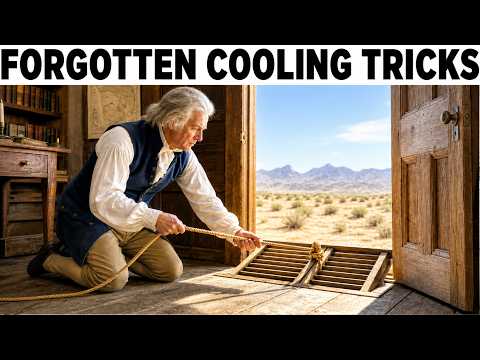
Stop Running Your AC This Summer — The Amish Build This $40 Underground Pipe in One Weekend
Summary
This video explains how to build an effective and affordable earth tube cooling system for homes, drawing on traditional Amish engineering. The system uses buried pipes to channel naturally cool earth air into a house, significantly reducing reliance on air conditioning and electricity bills. It details the correct depth, length, and crucial grading of the pipe, along with a forgotten dehumidification technique, to ensure optimal performance and longevity, contrasting it with common modern mistakes.
Key Insights
The earth's stable temperature at depth provides a free and infinite cooling source.
The video emphasizes that approximately 4 feet below the surface, the soil temperature remains consistently between 52-58°F (approx. 11-14°C) year-round in most of the US, regardless of the outside season. This stable temperature offers a readily available, free source of cool air that can be channeled into homes.
Proper installation, particularly pipe grading and dehumidification, is critical for effectiveness and preventing issues like mold.
Most modern earth tube systems fail due to incorrect installation. Key factors for success include burying the pipe at least 4 feet deep, using 100 feet of 4-inch smooth-wall pipe per 1,000 sq ft of house, and critically, ensuring every foot of pipe slopes downwards towards a drain to manage condensation. A specialized 'dew break' technique involving a small hump and a drain at 62 feet of run further separates condensed water, ensuring dry, cool air enters the house and preventing mold.
Sections
Introduction to Earth Tube Cooling
Traditional earth tube systems offer 40+ years of silent, low-cost cooling.
The speaker introduces a cooling system using a buried black pipe that provides 62°F air all summer for over 40 years with no electricity, motors, or compressors, unlike conventional air conditioning systems which have ongoing costs and shorter lifespans.
The technology is ancient but suppressed due to profit motives.
This cooling method has been used for over 100 years, with historical evidence in various cultures, but it is not widely known because it disrupts the profits of companies selling air conditioning and electricity. The speaker promises to explain how to build one for around $40.
Personal experience highlights the effectiveness and natural cooling sensation.
The speaker recounts a childhood experience in a root cellar where cool air poured up from the ground, likening it to 'the earth breathing cool'. This experience illustrates the principle of using the earth's natural temperature for climate control.
The Science of Stable Earth Temperatures
Soil temperature is constant at 4ft depth across the US.
At approximately 4 feet down, soil temperatures in much of the United States remain between 52°F and 58°F year-round, unaffected by surface weather conditions, whether it's freezing in winter or extremely hot in summer.
US government data confirms stable soil temperatures.
The US Department of Agriculture has recorded these stable soil temperatures at this depth since the 1930s, and this data is publicly available, confirming it's not folklore but a measurable phenomenon.
Earth tubes leverage this stable temperature for passive cooling.
By moving air slowly through a long pipe buried in the cool earth, the air is cooled down to near the soil's temperature before entering the house, providing an efficient passive cooling solution.
Critical Installation Steps for Success
Minimum depth of 4 feet is essential.
The pipe must be buried at least 4 feet deep. In sandy soil, which retains less cool than clay, digging 5 feet is recommended. This depth ensures the air interacts with the consistently cool earth.
Sufficient pipe length is required: 100ft per 1000 sq ft of house.
A rule of thumb is to use 100 feet of 4-inch diameter pipe for every 1,000 square feet of living space to be cooled. This can be split into two parallel runs for easier trenching and better airflow, such as two 50-foot runs.
Pipe must be graded downwards to manage condensation.
Every foot of the buried pipe must slope downwards, even slightly (1/4 inch per foot), towards a low point with a small drain. This ensures that condensation, which forms as warm, humid air cools, runs out of the pipe instead of pooling and causing mold and bad odors.
Use smooth-wall pipe, not corrugated drain pipe.
Smooth-wall SDR 35 sewer pipe is critical. Corrugated pipe traps moisture in its ridges, encouraging biofilm and mold growth. Smooth pipe allows water to flow freely towards the drain. SDR 35 is rated for burial, doesn't off-gas, and is relatively inexpensive.
Building the System for a Typical Home
Requires minimal yard space and no new construction.
This system is ideal for existing homes, including suburban lots. A strip of yard about 60 feet long and 3 feet wide is sufficient, and the pipe can be buried along fences or under future garden areas, becoming invisible once grass regrows.
Materials cost around $40 at a farm supply store.
The essential materials include 100 feet of 4-inch SDR 35 sewer pipe, two 90° sweeps, a coupling or two, and pea gravel. These typically cost about $40-$45.
Installation involves digging a trench and laying the pipe.
Digging the trench can be done by hand over a weekend or with a rented trencher. The pipe is laid with a downward slope away from the house. The far end (intake) comes up about 3 feet, capped with a stainless mesh screen.
A low-wattage fan and optional solar power ensure airflow.
A small, 6-inch inline duct fan (drawing about 30W, less than an old light bulb) is placed on the house end of the pipe to draw air through. This fan can be run from a wall outlet or a small solar panel, making the operational cost almost zero.
Completed systems provide significant cooling and low energy bills.
A properly installed system can cool a 1,600 sq ft house to a steady 72°F even on 95°F days without additional cooling. One example cited has a July electric bill of only $29, mostly for the refrigerator.
Historical Context and Why the Technology Was Suppressed
Government research in the 1970s showed potential, then funding ceased.
The US government published plans for residential earth tubes in the late 1970s during an energy crisis, conducting research and building demonstration homes. However, funding disappeared around 1983, and the concept was relegated to 'experimental'.
Economic interests benefited from promoting central air conditioning.
The speaker questions who profits from selling central AC units, electricity, financing, and replacement units if homeowners could use a $40 system for decades. Eliminating dependence on these industries is presented as the reason the technology was sidelined.
Knowledge persisted within self-sufficient communities.
Communities like the Amish, who are less reliant on the grid, retained this knowledge because they were not the target market for conventional cooling systems. The knowledge survived through practical application and generational transfer.
The Crucial 'Dew Break' Detail
A forgotten design detail prevents excessive moisture in the air.
The key detail, passed down from 1890s Swiss-German builders, is the 'dew break'. This involves creating a specific hump in the pipe to manage condensation and dehumidify the air before it enters the living space.
Condensation collects at a hump, preventing damp air.
Most condensation occurs in the first 60-70 feet where the temperature drop is steepest. By creating a 4-inch hump at this point, water collects in the low spot before the hump. A small pipe from this low spot drains the water into a gravel pit.
This ensures cool, dry air, like a mountain morning.
The air that passes the dew break is already dehumidified, resulting in cool, dry air, superior to the cool but damp air produced by systems without this feature. This detail is missing from most modern tutorials.
Practical knowledge from builders outweighs modern tutorials.
This vital detail was learned through centuries of practical building, observation, and record-keeping in farm ledgers, representing accumulated wisdom that is overlooked by many current DIY builders.
Practical Considerations and Common Questions
Depth recommendations vary by region and soil type.
For areas north of the surveyed band, 5 feet deep is recommended. In the deep south with high water tables and heat-retaining clay, 4 feet is the minimum, but a longer pipe run (around 120 feet) is advised for more contact time with cooler earth.
Simple sloping manages condensation without pumps.
A 1-inch drop per 10 feet of run, pitched away from the house towards a gravel sump at the far end, allows gravity to move condensate into the soil without needing pumps or electricity.
Mold is not an issue with proper installation and maintenance.
A properly sloped, sealed pipe flushed annually will not grow mold. Constant airflow and nightly drying prevent significant bacterial growth. University tests show bacterial counts inside these pipes are lower than in standard home ductwork.
Long-term cost savings compared to central AC are substantial.
While central AC can cost over $8,000 for energy over 20 years (plus $4,000+ in repairs), the $40 earth tube system lasts for decades. The fan uses minimal electricity (30W), comparable to an old light bulb, and can be solar-powered. The pipe itself is extremely durable.
Ask a Question
*Uses 1 Wisdom coin from your coin balance