Simulating a single brain cell
Summary
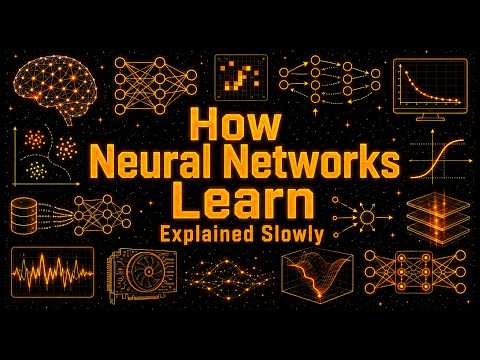
This video explains the core concepts of artificial neural networks by focusing on a single artificial neuron. It details how neurons process numerical inputs, learn through trial and error using gradient descent to adjust parameters (weights and biases), and are essentially mathematical functions. The video illustrates these principles with examples like predicting cannon shot distance and classifying mangoes, highlighting the limitations of a single neuron due to its linear nature and inability to solve non-linear problems like XOR.
Key Insights
Artificial neurons are mathematical functions that process numerical inputs and outputs.
Unlike biological neurons, artificial neurons are essentially mathematical functions that accept numerical inputs, perform calculations using parameters, and produce numerical outputs. Learning in ANNs involves adjusting these parameters.
Gradient descent is the core mechanism for trial-and-error learning in ANNs.
The process of effective trial and error in computer systems, enabling ANNs to learn, is achieved through an algorithm known as gradient descent.
Learning adjustments should be proportional to the slope of the error function.
To differentiate adjustments for weight and bias, the slope (derivative) of the error function with respect to each parameter is calculated. Adjustments are then made proportional to this slope, leading to more effective learning.
The error landscape (loss function) guides the gradient descent process.
The error, viewed as a function of the parameters (weight and bias), creates an 'error landscape'. Gradient descent involves moving 'downhill' on this landscape by making adjustments based on the slopes (gradients) to find a point with minimal error.
A loss function quantifies the error; gradient descent minimizes this loss.
The general mechanism for learning is to minimize a 'loss function', which measures how well the network performs on data. Gradient descent is the process of iteratively adjusting parameters to descend this loss landscape.
A single neuron is limited to linear separation of data categories.
A single artificial neuron, even with a sigmoid activation, can only learn to separate data using a single linear boundary. This is a fundamental limitation, as demonstrated by its inability to solve non-linear problems like the XOR gate or complex mango classification.
Sections
Introduction to Artificial Neural Networks
ANNs form the basis of modern AI systems like LLMs and image generators.
Artificial neural networks (ANNs) are the foundational technology behind many contemporary artificial intelligence systems, including large language models, image and video generators, image recognizers, some game-playing bots, content recommenders, and protein folding predictors.
Focusing on a single neuron simplifies understanding the complex ANNs.
To understand how complex ANNs work, the video focuses on analyzing small systems composed of a single artificial neuron, aiming to build a solid understanding of its function, learning capabilities, and limitations.
ANNs are inspired by the structure and function of biological brains.
Artificial neural networks were initially inspired by natural neural networks (brains), which consist of interconnected neurons that receive signals, process them, and can fire to send signals to other neurons, enabling complex information processing.
Artificial neurons are mathematical functions that process numerical inputs and outputs.
Unlike biological neurons, artificial neurons are essentially mathematical functions that accept numerical inputs, perform calculations using parameters, and produce numerical outputs. Learning in ANNs involves adjusting these parameters.
Learning in ANNs is a process of adjusting parameters using trial and error.
Learning in artificial neural networks is fundamentally a process of trial and error, where parameters of the mathematical function are adjusted iteratively until the function produces desired outputs for given inputs.
Gradient descent is the core mechanism for trial-and-error learning in ANNs.
The process of effective trial and error in computer systems, enabling ANNs to learn, is achieved through an algorithm known as gradient descent.
Single Neuron: Predicting Cannon Shot Distance
A single neuron can model a simple linear relationship using a weight parameter.
In a scenario predicting cannon shot distance based on initial kinetic energy, a single artificial neuron can represent this relationship as a linear function (y = wx), where 'w' is a learnable parameter called a weight.
Learning involves calculating error and adjusting the weight via trial and error.
The learning process for the neuron involves feeding an input (energy), predicting an output (distance), firing the cannon to get the actual distance, calculating the error, and then adjusting the weight. If the prediction was too high, the weight is decreased; if too low, it's increased.
The learning rate determines the step size for parameter adjustments.
The amount by which the weight is adjusted is controlled by the 'learning rate'. A constant adjustment can lead to overcorrection, while a smaller adjustment takes longer. Finding the right learning rate is crucial for efficient learning.
Introducing Bias to the Neuron
A bias parameter allows the neuron to model functions that don't pass through the origin.
To model functions that do not pass through the origin (like predicting distances from a moved cannon), a 'bias' parameter is added to the neuron's output. This allows the neuron to represent any linear function (y = wx + b).
Learning with multiple parameters requires distinct adjustment policies for each.
When a neuron has multiple parameters (weight and bias), they can become coupled if adjusted with the same rule. A different adjustment policy is needed to allow each parameter to be changed independently based on its impact on the error.
Learning adjustments should be proportional to the slope of the error function.
To differentiate adjustments for weight and bias, the slope (derivative) of the error function with respect to each parameter is calculated. Adjustments are then made proportional to this slope, leading to more effective learning.
The error landscape (loss function) guides the gradient descent process.
The error, viewed as a function of the parameters (weight and bias), creates an 'error landscape'. Gradient descent involves moving 'downhill' on this landscape by making adjustments based on the slopes (gradients) to find a point with minimal error.
A loss function quantifies the error; gradient descent minimizes this loss.
The general mechanism for learning is to minimize a 'loss function', which measures how well the network performs on data. Gradient descent is the process of iteratively adjusting parameters to descend this loss landscape.
Single Neuron: Classifying Mangoes
Neurons can be used for binary classification tasks by mapping outputs to categories.
A single neuron can be used for binary classification, such as identifying Tommy Atkins mangoes based on length. The neuron's numerical output needs to be mapped to a probability between 0 and 1.
The sigmoid function squashes neuron output to a 0-1 range for classification.
The sigmoid function is used to transform the unbounded output of a neuron into a value between 0 and 1. This output can be interpreted as a probability, suitable for classification tasks where categories are represented numerically (e.g., 0 for no, 1 for yes).
A single neuron is limited to linear separation of data categories.
A single artificial neuron, even with a sigmoid activation, can only learn to separate data using a single linear boundary. This is a fundamental limitation, as demonstrated by its inability to solve non-linear problems like the XOR gate or complex mango classification.
Limitations of a Single Neuron
Non-linear problems cannot be solved by a single neuron.
Complex tasks that cannot be solved by drawing a single straight line (or its higher-dimensional equivalent, a hyperplane) are beyond the capabilities of a single neuron. Examples include the XOR logical function and classifying datasets with overlapping regions.
Sudden transitions in loss functions created by linear outputs hinder learning.
If a neuron's raw linear output is used directly in a loss function without a smoother mapping like the sigmoid, it can create discontinuous or infinitely sloped regions in the loss landscape, making gradient descent ineffective for training.
Conclusion and Next Steps
Subsequent videos will cover multi-neuron networks and backpropagation for complex tasks.
The video concludes by summarizing that ANNs are learnable mathematical functions adjusted via gradient descent. It previews that the next video will explore systems with multiple neurons, introducing backpropagation to enable the learning of more versatile, non-linear functions.
Ask a Question
*Uses 1 Wisdom coin from your coin balance