Mastering Your Mind: 3 Levels of Thinking & 4 Habits for Growth
Summary
This article explores three levels of thinking: the NPC (reactive, script-following), the Main Character (rational, self-authored), and the Programmer (flexible, perspective-shifting). It argues that modern society's information ecosystem, driven by profit-seeking algorithms, fosters 'intellectual obesity' and traps individuals in lower levels of thinking. The key to overcoming this is developing cognitive flexibility through four daily habits: questioning, curating content, engaging in long-form reading, and consistent creation. These habits are presented as essential tools for modern survival and achieving life goals.
Key Insights
Achieving life goals is the ultimate test of intelligence, requiring cognitive flexibility to hold contradictory ideas and think deeply without immediate reaction.
The article posits that true intelligence isn't just about IQ, but about the ability to navigate life successfully by achieving one's desired outcomes. This is directly linked to cognitive flexibility, defined as the capacity to hold opposing ideas simultaneously and engage in prolonged, deep thinking without being sidetracked by emotional reactions to conflicting viewpoints. Most people, it argues, treat ideas as allegiances, making opposing views seem like threats, thus hindering their ability to think critically and make effective choices. The core aim is to move beyond simply reacting and instead enhance the mind's ability to process complex information, which in turn determines the opportunities one can perceive and capitalize on.
Modern society's information environment, driven by profit-maximizing algorithms, promotes intellectual obesity and traps individuals in lower levels of thinking.
The article identifies a critical problem: the modern information landscape, particularly social media, is designed to exploit human reward circuits. Companies, driven by profit, utilize algorithms that prioritize polarizing and inflammatory content because it captures attention. This leads to an 'intellectual obesity' where minds are constantly fed low-quality, distracting information, akin to addiction. This environment actively traps users in lower levels of thinking, promoting instant gratification ('one-marshmallow' thinking) over deeper, more meaningful engagement. The abundance of short-form, fragmented content further exacerbates this by preventing the mind from forming coherent thoughts or pursuing a specific purpose, leading to a constant state of low consciousness and chaos.
Sections
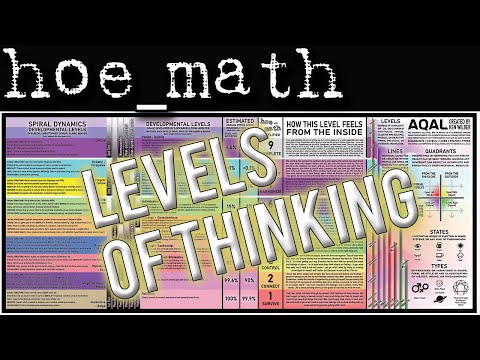
Three Levels of Thinking
Level 1: The NPC - follows scripts and treats authority as ground truth, lacking nuance.
Level 1 thinking is characterized by adherence to external scripts and dogmas, often derived from cultural conditioning, institutions, or influential figures like parents, priests, or celebrities. Individuals at this stage uncritically accept authority as absolute truth, finding it difficult to process nuance or paradox because their cognitive framework doesn't allow for holding contradictory ideas. Their identity is deeply intertwined with their group affiliations (job, religion, politics), making any questioning of these feel like a personal attack. This stage is described as pre-rational, where the world is seen in black and white, and a binary of 'us vs. them' dominates.
Level 2: The Main Character - rebels, questions authority, and pursues self-authorship based on logic and evidence.
The transition to Level 2 thinking marks a rebellion against assigned roles and a shift towards self-authorship. This stage is characterized by the birth of critical thinking as a default. Individuals begin questioning their upbringing, faith, career paths, and previously unquestioned authorities. The world is perceived as a puzzle with controllable choices. While logic and evidence become the new authority, replacing blind faith, there's a potential pitfall: substituting one form of unquestioned authority (tradition) for another (data, science). This is the rational stage, where individuals strive to write their own life script, define their own success, and choose their values.
Level 3: The Programmer - wields multiple perspectives, uses identity as a tool, and examines their own thinking process.
Level 3 thinking represents the highest cognitive flexibility, where identity and perspective are treated as tools rather than fixed states. Unlike Level 1 and Level 2 thinkers who typically operate from a single perspective, Level 3 thinkers can fluidly adopt multiple viewpoints as the situation demands (e.g., business lens, spiritual lens, scientific lens). This allows them to make decisions from a higher vantage point and solve problems more effectively. They can integrate seemingly contradictory ideas, including gut feelings and somatic knowing, which are often dismissed by Level 2 thinkers. The core difference is that Level 3 thinkers examine the act of thinking and scripting itself, understanding the 'operating system' of their mind and how to potentially rewrite it, leading to a deeper level of self-awareness and problem-solving.
Higher levels of thinking are temporary states and require conscious effort to maintain and compound for life success.
The article emphasizes that these levels of thinking are not fixed, permanent states but rather temporary conditions that individuals can enter or leave. Regression to Level 1 thinking is possible, particularly during times of stress. The crucial goal is therefore to increase the amount of time spent in higher levels of thinking, as this directly correlates with improved success and quality of life. Compounding time spent in higher cognition is presented as a tangible strategy for personal growth and achieving desired life outcomes.
The Modern Information Environment and Intellectual Obesity
The brain's evolved reward circuits are exploited by modern abundant resources, leading to addiction to information.
Human brains evolved dopamine reward circuits to incentivize seeking scarce resources like fat, sugar, and salt for survival. The emergence of the Industrial Age and subsequent technological advancements, particularly the internet and social media, created an environment where these resources, and equivalent information stimuli, became superabundant and easily manufactured. Companies leveraging advertising models discovered that content designed to maximize pleasure and engagement, often through polarizing or inflammatory means, captured the most attention. This created a dopamine-driven feedback loop, leading to an addiction to information, resulting in 'intellectual obesity' where minds are filled with low-quality, overwhelming data rather than valuable insights.
Social media algorithms prioritize reaction over thoughtful engagement, trapping users in low-consciousness states.
Instead of providing users with information they actively seek, social media algorithms are engineered to present content that users are most likely to react to emotionally. This prioritization of reaction over deep, contemplative thought actively traps individuals in lower levels of cognition. The constant influx of short-form, often meaningless content, lacks a through-line or a sense-making purpose. This bombardment prevents the mind from processing information effectively, leading to a state of chaos and hindering the development of deeper understanding and consciousness.
Long-form content (reading, writing) is centropic, healing the mind and enabling deeper, more meaningful thought.
In contrast to the entropic nature of short-form, fragmented content, long-form engagement, such as reading books or in-depth articles, is described as centropic. This type of engagement allows the mind to focus, digest information, and pursue more meaningful outcomes. It provides the necessary structure and depth for coherent thought, helping to organize attention and reduce mental chaos. By immersing oneself in longer pieces, individuals can move away from scattered thinking, reduce anxiety and overwhelm, and foster a more ordered and productive mental state, ultimately leading to a greater enjoyment of life and the ability to achieve more significant goals.
Social media and AI are tools, not enemies; the solution lies in leveraging them entrepreneurially, not discarding them.
The article advocates for viewing innovations like social media and AI not as problems to be eliminated, but as tools to be harnessed. It critiques a victim mentality that seeks to tear down new technologies and instead promotes an entrepreneurial spirit to solve the problems they introduce. Social media, in particular, is reframed as a powerful new education system for self-learners, a permissionless career path for creators, and a natural avenue for human creativity and fulfillment. The key is to use these platforms intentionally to build personal brands, share value, and contribute positively, rather than passively consuming ensnaring content.
Value creation through exploration, curiosity, and public sharing is a fulfilling, modern way to contribute positively.
The article champions the role of 'value creators' – individuals who dedicate themselves to exploring specific domains, pursuing curiosity, and publicly sharing their learnings in ways that benefit others. This process of problem identification, solution imagining, and bringing ideas into existence is presented as the antidote to the 'mechanical life' promoted by earlier industrial paradigms that could be soul-destroying. Being a personal brand or content creator is thus framed as a modern, leveraged way for humans to return to their creative nature, turning experience into value and contributing meaningfully to humanity.
Four Daily Habits to Enhance Higher Thought
Breaking current thinking habits and retraining the mind requires conscious daily practices.
Improving one's cognitive capacity and breaking free from detrimental thinking patterns hinges on a two-pronged approach: first, consciously dismantling ingrained habits of thought, and second, actively retraining the mind to engage in new, more productive directions. This process is fundamentally about habit formation. The article stresses that consistent daily actions are paramount, determining whether one's ability to think improves or deteriorates. Therefore, cultivating specific, beneficial habits is the cornerstone of mental transformation.
Prerequisite: Align your environment with your ideal self by ruthlessly curating information and experiences.
Before even starting the four daily habits, a critical prerequisite is to meticulously align one's environment with their desired ideal self across mind, body, spirit, and business. This involves being highly selective about the information and experiences one is exposed to, as these quietly influence internal ideas, which in turn shape behavior and identity. The article urges readers to be 'ruthless' in unfollowing distracting accounts, blocking negative influences, and paying close attention to social circles and daily interactions. This proactive environmental control is presented as essential for protecting one's mind from infiltration and maintaining focus on personal growth.
Habit 1: Questioning - Develop a habit of continuous inquiry to prevent stagnation and intellectual death.
The most potent tool for thinking is asking questions, and the cessation of questioning signifies the end of thinking. Stupidity begins when an answer becomes too comfortable, solidifying into an identity that perceives any challenge as an attack. This applies to archetypes like the stagnant expert, the perpetual victim who deflects responsibility, and the false-dichotomy thinker entrenched in 'us vs. them' mentalities. To escape such limitations, one must cultivate a natural process of asking questions, consistently probing assumptions and seeking deeper understanding. Dedicating specific time daily to questioning one's own thought processes is crucial for mental growth.
Habit 2: Curate - Actively manage your information intake to avoid mental junk food and reinvent yourself.
Consuming from uncurated feeds is akin to eating 'junk food' for the mind, as these feeds are often engineered for addiction and cheap dopamine. Curating information is thus presented as a mental diet essential for agility and fitness. By deliberately managing what information one consumes—saving specific links, using social media lists, subscribing to curated newsletters, or reading books—individuals can actively 'reinvent' themselves. This habit ensures that exposure to information directly influences behavior and identity in a positive, directed manner, rather than passively accepting whatever the algorithm serves.
Habit 3: Read - Engage with long-form content (books) to order attention and expand intellectual capacity.
The article emphasizes reading actual books and engaging with long-form content as a vital habit for intellectual growth. Short-form content scatters attention and prevents digestion, leading to mental 'damage.' In contrast, long-form reading orders attention, allowing for deeper processing and understanding. This habit exposes individuals to new ideas that can redirect their lives, trains the mind to think less erratically, and fosters a greater enjoyment of life. It counters the 'psychic entropy'—the mind's tendency toward disorder—caused by unfocused attention and conflicting inputs, thereby reducing anxiety and overwhelm.
Habit 4: Create - Actively build or produce something to solidify learning and avoid intellectual obesity.
Even with daily questioning, curating, and reading, one can remain intellectually obese without active creation. The article likens this to eating without exercising, leading to mental stagnation. The 'flow state,' or optimal experience, involves balancing information input with output. Simply consuming knowledge (even advanced ideas) without application, such as writing, building, or designing, doesn't foster true growth. The imperative is to create one's own projects—a brand, business, essay, or artwork—to transform consumed information into tangible value and move from being a passive consumer to an active creator, fulfilling a fundamental human need for creation.
Daily execution of these four 10-minute habits transforms the mind and improves life outcomes.
The article stresses the importance of making these four habits—questioning, curating, reading, and creating—a non-negotiable part of one's daily routine. It suggests dedicating just 10 minutes to each, emphasizing consistency over duration. To ensure these habits stick, readers are advised to time-block them, write them down, set reminders, and treat them as rituals, nearly forcing themselves to engage daily. The cumulative effect of these consistent, focused practices is presented as the key to fundamentally transforming one's mind and, consequently, improving the quality of life and problem-solving ability.
Ask a Question
*Uses 1 Wisdom coin from your coin balance