Learn 97% of AWS in Under 30 Minutes (Beginner to Pro)
Summary
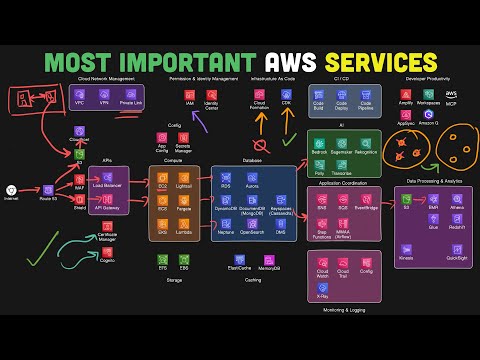
This video explains how to build a robust live event ticketing platform on AWS by dissecting a real-world application flow. It emphasizes understanding services based on the problems they solve rather than memorizing them. The core thesis is that a deep grasp of a few key services and their interconnections is more valuable than knowing all 200+ AWS services. The walkthrough covers customer interaction from browsing to purchase confirmation, detailing essential AWS services like Route 53, CloudFront, S3, VPC, Load Balancers, EC2, Auto Scaling, RDS, DynamoDB, SQS, Lambda, and SES, while also highlighting crucial aspects like security, monitoring, and infrastructure as code for building scalable and reliable cloud systems.
Key Insights
CloudFront delivers static content globally for faster user load times.
To overcome latency from storing files in a single region, AWS CloudFront, a Content Delivery Network (CDN), is used. It caches files at hundreds of edge locations worldwide, serving content from the nearest location to the customer, dramatically speeding up page load times, especially crucial during high-demand events.
Auto Scaling Groups dynamically adjust server capacity based on demand.
Auto Scaling Groups monitor server utilization and automatically launch new EC2 instances when load increases, and terminate them when the load decreases. This ensures sufficient resources are available during traffic spikes without incurring costs for idle servers, working in tandem with load balancers.
DynamoDB provides high-speed, scalable lookups for real-time seat availability.
For high-volume, simple status checks like seat availability, AWS DynamoDB, a NoSQL database, is more efficient than RDS. It stores each seat status as a record with fast key-based lookups and scales automatically, handling millions of requests per second without complex joins.
DynamoDB's conditional updates atomically check and reserve seats, preventing double sales.
The critical protection against double selling comes from DynamoDB's atomic conditional update. It performs the check for seat availability and the update to reserve it as a single, indivisible operation. If the seat is available, it's reserved; otherwise, the update fails, preventing concurrent purchases of the same seat.
Understanding AWS is problem-solving, not service memorization.
The most crucial takeaway is that AWS services should be learned based on the problems they solve. Every service chosen for an architecture must have a justifiable reason for its selection and how it addresses a specific challenge, which fundamentally changes how one approaches cloud design.
Sections
Introduction and Core Problem
Focus on essential AWS services, not all 200+, for real-world application.
Learning all 200+ AWS services can be overwhelming. In practice, 15-25 services handle the majority of cloud infrastructure needs. Understanding these core services and their connections empowers individuals to confidently discuss real-world cloud systems, even in job interviews.
A live event ticketing platform highlights critical AWS service requirements under extreme load.
A live event ticketing platform, especially during major artist tour drops or popular events, creates extreme traffic spikes. This scenario necessitates understanding how to build systems that load quickly, survive sudden surges, handle thousands of database requests, prevent double-selling, and ensure immediate customer confirmation.
The video breaks down a customer journey through AWS services for a complete real-world application.
The entire system is explained in 10 steps, following a single customer from typing the website address to receiving a confirmation email. Each step details the AWS service involved, the problem it solves, why it's used, and how it connects to other services, illustrating how core AWS services form one integrated system.
Step 1: Customer Access and Domain Resolution
Route 53 resolves domain names to IP addresses for customer access.
When a customer types a website address (e.g., live tickets.com), their browser uses DNS to find the corresponding IP address. AWS Route 53 manages this DNS resolution, pointing the domain name to the correct IP address of the AWS infrastructure. Caching can reduce the need for direct Route 53 contact on every visit.
Step 2: Delivering Web Page Content
Distinguish between static and dynamic content for efficient delivery.
Web pages consist of static files (images, layouts, styling) that are the same for all users and dynamic content (user-specific information like available tickets) that requires real-time processing. Handling them separately optimizes performance and resource usage.
S3 stores static files reliably and cost-effectively in the cloud.
AWS Simple Storage Service (S3) is used to store static website files like images, layouts, and styling. It offers virtually unlimited, highly reliable storage at a low cost, making files available whenever needed.
CloudFront delivers static content globally for faster user load times.
To overcome latency from storing files in a single region, AWS CloudFront, a Content Delivery Network (CDN), is used. It caches files at hundreds of edge locations worldwide, serving content from the nearest location to the customer, dramatically speeding up page load times, especially crucial during high-demand events.
Step 3: Network Isolation and Security
VPC creates an isolated network environment within AWS for security.
A Virtual Private Cloud (VPC) provides a logically isolated section of the AWS cloud, acting like a private floor in a shared building. It allows users to define their own network configurations and security rules, controlling inbound and outbound traffic.
Subnets (public/private) organize resources within a VPC for controlled access.
Within a VPC, resources are organized into subnets. Public subnets have a route to the internet (used for resources like load balancers), while private subnets do not and are used for more sensitive resources like application servers and databases, preventing direct internet access.
Step 4: Load Balancing and Auto Scaling
Application Load Balancer (ALB) distributes incoming traffic across multiple servers.
The Application Load Balancer (ALB) sits in a public subnet and acts as the entry point for internet traffic. It distributes requests across healthy backend servers, preventing any single server from being overwhelmed and ensuring high availability by rerouting traffic away from unhealthy instances.
Auto Scaling Groups dynamically adjust server capacity based on demand.
Auto Scaling Groups monitor server utilization and automatically launch new EC2 instances when load increases, and terminate them when the load decreases. This ensures sufficient resources are available during traffic spikes without incurring costs for idle servers, working in tandem with load balancers.
Step 5: Compute Layer (EC2 Instances)
EC2 instances provide virtual servers for running application code.
Elastic Compute Cloud (EC2) instances are virtual computers in AWS data centers where the actual application code runs. Users choose the instance's specifications (CPU, memory, OS). These instances reside in private subnets, accessible only through the load balancer for security.
EC2 offers full control and scales reliably for continuous workloads.
EC2 instances are suitable for tasks that run continuously and require a full server environment. They provide granular control over the compute layer and scale effectively with demand when paired with Auto Scaling Groups, offering a simpler alternative to containerized solutions like ECS/EKS for beginners.
Step 6 & 7: Database Services for Event Data and Seat Availability
RDS manages relational data for event details and complex queries.
AWS Relational Database Service (RDS) is used for storing structured event data, such as artist names, venues, pricing, and seating maps. It operates within a private subnet and supports complex queries and relationships between data, similar to interconnected spreadsheets.
DynamoDB provides high-speed, scalable lookups for real-time seat availability.
For high-volume, simple status checks like seat availability, AWS DynamoDB, a NoSQL database, is more efficient than RDS. It stores each seat status as a record with fast key-based lookups and scales automatically, handling millions of requests per second without complex joins.
DynamoDB is a managed service outside the VPC, accessed via secure endpoints.
DynamoDB is a regional managed service run by AWS outside the user's VPC. EC2 instances securely connect to it using mechanisms like VPC endpoints, ensuring that traffic to the managed service stays within the AWS network, enhancing security.
Step 8: Preventing Double Sales with Queues and Conditional Updates
SQS FIFO queues ensure ordered processing of purchase requests for critical resources.
To prevent double-selling, purchase requests are sent to an AWS Simple Queue Service (SQS) FIFO (First-In, First-Out) queue. Messages are grouped by event and seat, ensuring that all attempts to purchase the same seat are processed sequentially, while purchases for different seats can proceed in parallel.
DynamoDB's conditional updates atomically check and reserve seats, preventing double sales.
The critical protection against double selling comes from DynamoDB's atomic conditional update. It performs the check for seat availability and the update to reserve it as a single, indivisible operation. If the seat is available, it's reserved; otherwise, the update fails, preventing concurrent purchases of the same seat.
Decoupling services via queues enhances resilience and independent scaling.
Using SQS decouples the purchase request reception from the processing logic. If the processing system temporarily goes down, messages remain in the queue, ensuring no loss and allowing the system to resume where it left off. This separation (decoupling) is a key cloud architecture principle.
Step 9: Confirmation Emails with Lambda and SES
AWS Lambda executes short, event-driven tasks like sending confirmation emails.
AWS Lambda is a serverless compute service that runs code in response to triggers. For tasks like formatting and sending confirmation emails, Lambda is triggered by messages from the SQS queue. It executes the code, performs the necessary actions (like calling SES), and then stops, incurring no cost when idle.
Simple Email Service (SES) handles bulk email sending at scale.
AWS Simple Email Service (SES) is specifically designed for sending emails at scale. Lambda formats the confirmation email content and then calls SES to deliver it to the customer's inbox, separating the logic (Lambda) from the delivery mechanism (SES).
Step 10: Cross-Cutting Concerns: Security, Monitoring, and IaC
Security Groups and IAM enforce granular access control for all resources.
Security Groups act as virtual firewalls for resources, controlling network traffic. IAM (Identity and Access Management) defines what actions services and users are allowed to perform. Together, they ensure that only explicitly permitted connections and actions can occur, limiting the blast radius of any potential compromise.
CloudWatch provides comprehensive monitoring and alerting for system health.
AWS CloudWatch collects metrics and logs from services, providing insights into system performance (CPU usage, errors, latency). It enables dashboards for at-a-glance health checks and alarms that can trigger notifications or automated responses, such as scaling actions.
Infrastructure as Code (IaC) enables automated, repeatable environment deployment.
Infrastructure as Code tools like AWS CloudFormation or Terraform allow defining infrastructure (services, configurations, security rules) in code files. This ensures consistent, repeatable deployments, simplifies managing and versioning infrastructure, and resolves the problem of recreating complex setups accurately over time.
Understanding AWS is problem-solving, not service memorization.
The most crucial takeaway is that AWS services should be learned based on the problems they solve. Every service chosen for an architecture must have a justifiable reason for its selection and how it addresses a specific challenge, which fundamentally changes how one approaches cloud design.
Ask a Question
*Uses 1 Wisdom coin from your coin balance