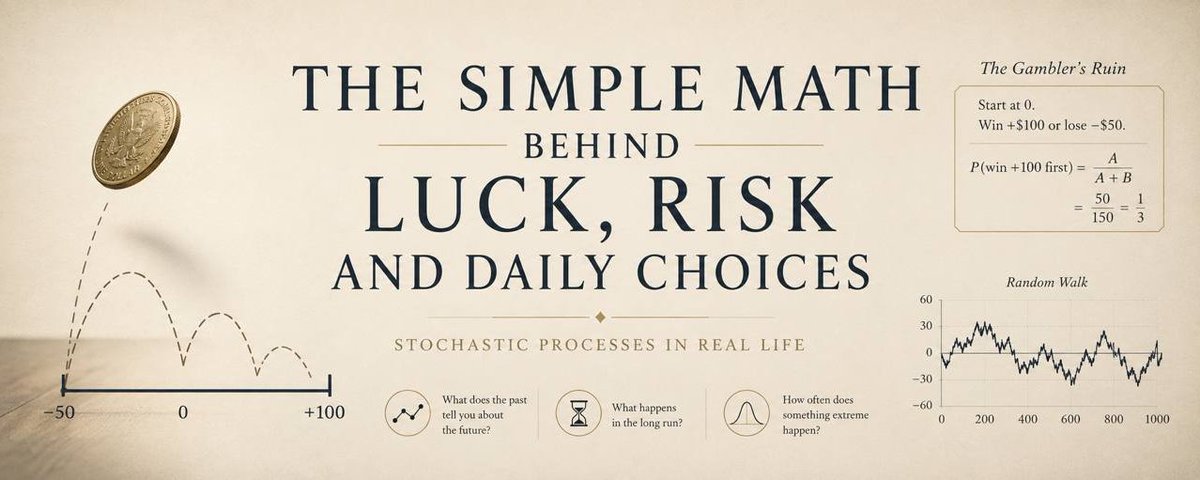
How To Manufacture Luck
Summary
This content explores the concept of 'Luck Surface Area' (LSA), proposing that luck is not purely random but can be engineered through a combination of passionate 'doing' and effective 'telling'. It introduces four types of luck, from pure chance to reputation-driven opportunity, and provides actionable rules to increase LSA. These rules emphasize taking numerous actions, acting decisively, experimenting, embracing reversible decisions, persevering, and sharing one's work to attract serendipitous opportunities.
Key Insights
LSA is directly proportional to passion and effective communication.
Jason Roberts defines Luck Surface Area as directly proportional to the degree to which you do something you’re passionate about combined with the total number of people to whom this is effectively communicated. Each rule presented aims to gently tilt the odds in your favor to increase this area.
The LSA model: Luck = Doing × Telling.
The core model is L = D × T, where L is Luck (probability of serendipitous encounter), D is 'Doing' (passion, action, expertise development), and T is 'Telling' (effectiveness and reach of communication). A larger D and T significantly increase LSA. Without 'Doing,' 'Telling' has no value.
Type IV Luck: Attracting Opportunity.
The most potent form, where unique character and reputation attract opportunities. The flow of luck becomes deterministic as the opportunity seeks you based on your extreme differentiation and 'Personal Monopoly.' Heavy reliance on the 'Telling' variable.
Share Your Work.
Don't keep passions and projects secret; communicate them widely. Doing meaningful work and ensuring people know about it expands your 'luck surface.' This combination invites unexpected opportunities and raises your antenna.
Sections
Introduction to Luck Surface Area
Luck is not just skill or chance; it's influenced by actions and environment.
The traditional views of success as purely meritocratic (skill and effort) or purely fatalistic (chance) miss a crucial aspect. Luck often arises because our habits and choices position us to encounter it. The concept of 'Luck Surface Area' (LSA) suggests that the more you build, learn, and connect, the more chances you create for good surprises to find you.
LSA is directly proportional to passion and effective communication.
Jason Roberts defines Luck Surface Area as directly proportional to the degree to which you do something you’re passionate about combined with the total number of people to whom this is effectively communicated. Each rule presented aims to gently tilt the odds in your favor to increase this area.
Luck is a compound outcome of preparation, motion, and chance.
Luck is not a singular force but a composite result, stemming from the interplay of how prepared you are, the actions you take, and random chance. This perspective shifts control from pure randomness to influenced outcomes.
The LSA model: Luck = Doing × Telling.
The core model is L = D × T, where L is Luck (probability of serendipitous encounter), D is 'Doing' (passion, action, expertise development), and T is 'Telling' (effectiveness and reach of communication). A larger D and T significantly increase LSA. Without 'Doing,' 'Telling' has no value.
'Doing' represents potential energy; 'Telling' multiplies it into opportunity.
The 'Doing' variable (D) represents the substance created through skills, projects, and value creation. The 'Telling' variable (T) acts as a multiplier, converting this potential into tangible opportunities. Expertise in isolation yields minimal luck; communication expands its reach.
LSA determines the capture rate of opportunities.
The world is full of potential opportunities like deals, jobs, or projects. Your Luck Surface Area dictates what percentage of these you can capture. You can't control external events (lightning strikes) but can control your LSA (height and conductivity of the lightning rod).
Types of Luck
Type I Luck: Pure Chance.
This is luck entirely by accident, like winning a lottery or inheriting wealth. It's the baseline noise of the system and cannot be increased by agency. Risks associated with bad Type I luck can be mitigated through defensive strategies.
Type II Luck: Physical and Intellectual Motion.
This 'hustler's luck' comes from generating a high volume of actions (networking, outreach, experimentation). It relies on the Law of Large Numbers: more trials (n) increase the probability of success (P = 1 - (1-p)^n). The heuristic is 'action over inaction.'
Type III Luck: The Prepared Mind.
This luck involves recognizing opportunities invisible to others due to a lack of specific knowledge or experience. It hinges on pattern recognition and domain expertise, transforming background noise into actionable signals through deep study.
Type IV Luck: Attracting Opportunity.
The most potent form, where unique character and reputation attract opportunities. The flow of luck becomes deterministic as the opportunity seeks you based on your extreme differentiation and 'Personal Monopoly.' Heavy reliance on the 'Telling' variable.
Rules for Increasing Luck Surface Area
Take Lots of Shots.
Increase the number of attempts in your endeavors like projects or applications. Each attempt is a lottery ticket; you can't predict success but can control the quantity of attempts. Prolific creators and investors often benefit from this volume approach.
Do Something.
Prioritize action over endless deliberation. Starting imperfectly is better than not starting at all. Each action, however small, creates feedback, connections, and potential opportunities that inaction prevents.
Treat Projects as Experiments.
Embrace experimentation with rapid feedback loops. Test ideas quickly, learn from outcomes, and pivot if something isn't working. This agility allows redirection towards more promising avenues and increases the chance of eventual success.
Go Down the Ladder to Climb a Taller One.
Don't fear temporary setbacks if they pave the way for greater future gains. Leaving your comfort zone or foregoing small immediate successes can position you for significantly larger achievements later.
Make Easily Reversible Decisions.
Treat non-critical choices as reversible. This allows for quick action and continuous progress, as you can easily change course. Differentiate between reversible 'two-way doors' and irreversible 'one-way doors' to speed up decision-making.
Persevere Through Difficulties.
Persistence is key; often, 'luckiest' individuals are those who simply don't quit. Sustained effort through challenges increases opportunities for success to compound over time, turning perceived overnight successes into long-term achievements.
Share Your Work.
Don't keep passions and projects secret; communicate them widely. Doing meaningful work and ensuring people know about it expands your 'luck surface.' This combination invites unexpected opportunities and raises your antenna.
Ask a Question
*Uses 1 Wisdom coin from your coin balance
Watch / Source Article
How To Manufacture Luck
Read the original web article directly on polymathinvestor.com
Open Web Note Link