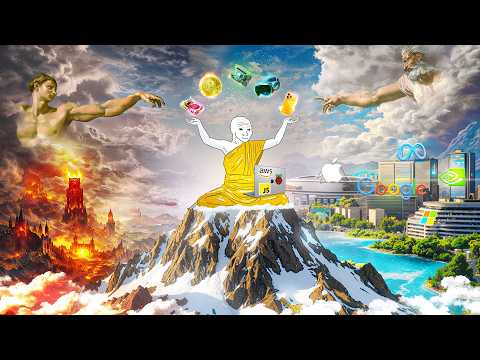
History of the Entire World (Ancient, Medieval, Modern) | World History Documentary
Summary
This video provides a sweeping overview of world history, tracing human evolution from early primates to Homo sapiens, the development of tools and fire, and the Agricultural Revolution. It then delves into the rise and fall of major ancient civilizations like Mesopotamia, Egypt, Greece, and Rome, followed by the medieval period across continents, highlighting empires, trade routes, and cultural exchanges. The narrative continues through the early modern era, encompassing the Renaissance, Reformation, Age of Discovery, and global empires, leading into the Industrial and Technological Revolutions. It culminates with the 20th century's world wars, the Cold War, and the dawn of the information age, posing questions about humanity's future trajectory.
Key Insights
The aridity and Savannah hypotheses suggest climate change drove bipedalism and tool use.
The aridity hypothesis suggests climate change and Savannah expansion drove early human adaptation. The Savannah hypothesis posits this led early humans to leave trees, become bipedal on grasslands, enabling better long-distance vision, efficient travel, and freeing hands for tool use.
Agriculture led to social hierarchy, population growth, division of labor, and health issues.
The Neolithic Revolution caused profound societal changes: replacing egalitarian groups with social hierarchies. Food surpluses enabled population growth and full-time roles like soldiers, craftsmen, and administrators. Physical health declined due to less activity and pathogen spread from close animal proximity, alongside vitamin deficiencies and poorer dental growth. This revolution laid the groundwork for modern sedentary society, population growth, division of labor, and social stratification.
China experienced golden ages under the Sui, Tang, and Song dynasties, advancing in technology and economy.
China saw unification under the Sui Dynasty, followed by the technologically and economically advanced Tang and Song dynasties. The Song Dynasty, focusing on maritime trade and using coal-powered machines, experienced an 'industrial revolution.' China became the world's top economy, three times larger than Europe's combined.
The Scientific Revolution, starting with heliocentrism, transformed understanding of the natural world.
Building on Renaissance ideals, the Scientific Revolution saw thinkers like Copernicus, Galileo, and Newton challenge established Aristotelian physics and the geocentric model. Inductive reasoning and observation became paramount, leading to major advancements in physics, biology, and geology.
The Enlightenment championed reason, individual rights, and challenged absolute monarchy and divine right.
The Enlightenment, an intellectual revolution, emphasized reason, natural rights (liberty, equality), and secularism. Thinkers like Locke, Rousseau, and Descartes influenced political thought, challenging absolute monarchies and paving the way for revolutions in America and France.
The Industrial Revolution began in Europe, transforming production with new technologies like the steam engine.
Beginning in the late 1700s, the Industrial Revolution utilized inventions like the steam engine (improved by Watt and Bolton) to power factories, particularly in textiles. This shifted society from manual labor to machine production, leading to urbanization and exponential economic growth.
The interwar period saw economic instability (Great Depression) and the rise of authoritarian regimes.
The Roaring Twenties' prosperity ended with the Wall Street Crash of 1929, plunging the world into the Great Depression. This economic crisis fueled political polarization, leading to the rise of authoritarian regimes in Italy (Mussolini) and Germany (Hitler), who undermined the League of Nations.
The Cold War emerged between the US and USSR, characterized by nuclear standoff and proxy wars.
Post-WWII, the US and USSR emerged as superpowers, leading to the Cold War. This ideological conflict involved a nuclear arms race, the formation of NATO and the Warsaw Pact, and proxy wars (Korea, Vietnam, Afghanistan) due to the doctrine of Mutually Assured Destruction (MAD).
Sections
Early Human Evolution and Prehistory
Primates diverged from other mammals around 85 million years ago, leading to hominids.
Human lineage traces back to around 85 million years ago when primates diverged from other mammalian ancestors, forming the family homin or hominids. This group initially included apes and orangutans. Approximately 8.5 million years ago, the homini diverged from the galini, who became gorillas. About 7.5 million years ago, early humans and chimpanzees diverged from each other under the homini branch.
Early human species evolved through distinct stages, developing tools and fire.
Humans evolved in stages: Orrin sahil anthropus and ardipithecus (up to 7 million years ago), Australopithecus (4 million years ago), Paran Rus (2.7 million years ago), and genus Homo (1.8 million years ago). Homo habilis used crude stone tools, while Homo erectus developed better tools and mastered fire. Homo heidelbergensis appeared around 800,000 years ago, and Homo sapiens emerged 150-200,000 years ago. Neanderthals diverged 600-700,000 years ago and eventually became extinct despite interbreeding with Homo sapiens.
The aridity and Savannah hypotheses suggest climate change drove bipedalism and tool use.
The aridity hypothesis suggests climate change and Savannah expansion drove early human adaptation. The Savannah hypothesis posits this led early humans to leave trees, become bipedal on grasslands, enabling better long-distance vision, efficient travel, and freeing hands for tool use.
Bipedalism caused significant physical changes and shortened human gestation periods.
Walking upright on the Savannah led to skeletal changes in legs and back, and a more burdensome pelvis for childbirth. Gestation periods shortened to allow babies to pass through the birth canal before their heads grew too large, contributing to human babies' helplessness and prolonged development.
The Paleolithic era (99% of technological prehistory) saw nomadic hunter-gatherers use fire and develop early art.
The Paleolithic era, from 3.3 million years ago to 12,000 years ago, represents 99% of our technological prehistory. Early humans lived in small, nomadic tribal societies, hunting, foraging, and using fire. During the Middle Paleolithic (from 300,000 years ago), primitive art and spiritual practices emerged. Nomadism led to global migration, following the 'Out of Africa' theory.
The Neolithic Revolution transformed society from nomadic to sedentary due to agriculture.
Around 12,000 years ago, the Neolithic Revolution (Agricultural Revolution) began, with humans domesticating plants and animals, transitioning from nomadic to sedentary lifestyles. Theories suggest this started in the hilly flanks of the Taurus and Zagros Mountains or was driven by a desire for food surpluses for power display.
Agriculture led to social hierarchy, population growth, division of labor, and health issues.
The Neolithic Revolution caused profound societal changes: replacing egalitarian groups with social hierarchies. Food surpluses enabled population growth and full-time roles like soldiers, craftsmen, and administrators. Physical health declined due to less activity and pathogen spread from close animal proximity, alongside vitamin deficiencies and poorer dental growth. This revolution laid the groundwork for modern sedentary society, population growth, division of labor, and social stratification.
The Ancient Period: Cradle of Civilizations
Mesopotamia, between the Tigris and Euphrates, was a cradle of civilization, developing writing and empires.
The ancient period, from Sumerian writing (c. 3400 BC) to the fall of Rome (5th Century CE), saw the birth of major civilizations. Mesopotamia, the land between the Tigris and Euphrates, was a primary cradle. Early settlements date to 6500 BC (Ubaid period), followed by urban centers in the Uruk period (c. 4100 BC). Sumerian civilization emerged, developing cuneiform writing around 3100 BC. The Early Dynastic period (2900 BC) saw city-states and trade. The Akkadian Empire under Sargon (c. 2340 BCE) was arguably the first empire, integrating cultures but replacing Sumerian language.
Empires rose and fell in Mesopotamia: Akkadian, Neo-Sumerian, Babylonian, Hittite, Kassite, Assyrian, and Neo-Babylonian.
After the Akkadians fell to Gutians, the Neo-Sumerian Empire (c. 2112 BC) saw a Sumerian Renaissance. Babylon grew into an Amorite city, and Hammurabi ruled the first Babylonian Empire (1792 BC), known for his law code. After Hammurabi's death, the Hittites sacked Babylon (1595 BC), leading to Kassite rule for nearly 500 years. The Bronze Age collapse (12th century BC) paved the way for the Neo-Assyrian Empire (c. 911 BC), the largest yet. Babylon revolted (626 BC) to form the Neo-Babylonian Empire, known for Nebuchadnezzar II's destruction of Jerusalem (587 BC).
The Achaemenid Empire, founded by Cyrus the Great, expanded vastly and warred with Greek city-states.
Cyrus of the Achaemenid Empire established a vast empire (550 BCE), freeing Jews from captivity. The empire, reaching 8 million sq km under Xerxes, was known for wars with Greek city-states. It eventually crumbled to Alexander the Great.
Following Alexander's conquests, the Seleucid dynasty and later the Parthians and Sassanians ruled Persia.
After Alexander's death, Persia became the Hellenistic Seleucid dynasty. Native Persians under the Parthians retook the region (247 BC), forming the third Iranian Empire, clashing with Romans. The Sasanian Empire (224 CE - mid-600s CE) was the longest and most successful Persian empire, considered Rome's equal.
Israel and Judah faced Assyrian and Babylonian conquests, with periods of exile and return.
West of Persia, Israel and Judah emerged in the 9th century BC. They fell under the Neo-Assyrians, who destroyed Samaria (722 BC). In the 500s BC, the Neo-Babylonians destroyed Jerusalem after revolts. After Babylonian fall to Achaemenids, Jews returned. The Seleucids later faced the Maccabean Revolt against Hellenistic culture.
Phoenicia's maritime trade led to colonies like Carthage, a major rival to Rome.
Phoenicia, on the coast of modern Lebanon/Syria, spread maritime trade across the Mediterranean. They founded Carthage in North Africa (814 BC), which became the heart of their civilization. Carthage fiercely rivaled Rome, leading to the Punic Wars, culminating in Rome's destruction of Carthage.
Ancient Egypt, unified around 3000 BC, saw grand constructions in the Old Kingdom and prosperity in the New Kingdom.
Egypt, unified around 3000 BC, saw massive constructions like the Great Sphinx and Giza Pyramids during the Old Kingdom (2686 BC). The New Kingdom (1549 BC) was its most prosperous. After the Bronze Age collapse, Egypt survived but weakened, falling under Assyrian, Achaemenid, Hellenistic, and finally Roman rule.
Nubia, south of Egypt, shared culture and religion, with its Kushite rulers becoming pharaohs.
South of Egypt lay Nubia, home to the Kushites, who shared much of Egyptian culture and religion. They coexisted with Egypt and even ruled as pharaohs (25th Dynasty, 8th century BC). Nubia held women in high regard, with Candaces as ruling queens.
Ancient Africa saw civilizations like Nok in Nigeria and Jian in Mali, and the Indus Valley Civilization in India.
In West Africa (Nigeria), the Nok culture (1000 BCE - 200 CE) created advanced terracotta figures, possibly influenced by Egyptians. The Jian, near the Niger River in Mali (250 BC - 900 CE), was an early urban center. In South Asia, the Indus Valley Civilization (c. 3300 BC) flourished before being replaced around 1700 BCE.
India's civilizations included the Indus Valley, Vedic period, Mahajanapadas, Nanda, and Maurya Empires.
The Indus Valley Civilization (c. 3300-1700 BCE) was followed by the Vedic period (c. 1500-500 BCE). By 500 BCE, Northern India had 16 kingdoms (Mahajanapadas). The Nanda Empire arose but was dissolved by Chandragupta Maurya (c. 322 BCE), founding the Maurya Empire, instrumental in Buddhism's spread via Ashoka the Great.
China's Yellow River Valley was a cradle of civilization, with dynasties like Xia, Shang, Zhou, Qin, and Han.
The Yellow River Valley hosted early Chinese civilization. The Xia Dynasty (c. 2070-1600 BC), possibly the Erlitou culture, was followed by the Shang (c. 1600-1046 BC). The Zhou Dynasty (c. 1046 BCE) introduced the Mandate of Heaven. Decentralization led to the Spring and Autumn and Waring States periods. The Qin Dynasty unified China (221 BC) under Qin Shi Huang, initiating the Great Wall and legalism. The Han Dynasty (202 BC - 220 CE) prospered and established the Silk Road.
The Americas developed independent civilizations like the Olmec, Maya, and Andean cultures.
North America had mound-builder cultures like Poverty Point (c. 1700 BC) and the Woodland period (c. 1000 BC), including Hopewell. Mesoamerica saw the Olmec early on (c. 2500 BC), followed by the Maya, Zapotec, Mixtec, and Teotihuacan. Mesoamerica independently invented writing. South America's Norte Chico civilization (c. 3500 BC) was the earliest in the Americas. Andean civilizations developed independently, using quipu for communication.
Europe saw the Minoan civilization on Crete and the Mycenaean civilization, precursors to Greek culture.
In Europe, the Minoan civilization on Crete (c. 3600 BC) was the oldest, with urban centers developing around 2000 BC. They were eventually overrun by the Mycenaeans from mainland Greece. The Mycenaeans were victims of the Bronze Age collapse (c. 1100 BC), leading to the Greek Dark Ages.
Ancient Greece developed city-states, democracy, philosophy, and theater during its Archaic and Classical ages.
Greece's Archaic Age (c. 750-480 BC) saw the rise of city-states and early democracy (Solon in Athens). The Classical Age (post-Persian invasion) featured the Delian League (Athens) and Peloponnesian League (Sparta), fostering philosophy, theater, science, and art, forming the foundation of Western culture.
The Roman Republic transitioned to Empire, conquering the Mediterranean and adopting Greek culture.
Rome, founded c. 753 BCE, transitioned from monarchy to Republic (509 BC) and then Empire (27 BC with Augustus). After destroying Carthage, Rome controlled the Mediterranean. They adopted much of Greek culture, excelling in infrastructure and technology. The Empire faced crises, eventually splitting into East and West.
Warfare became professionalized due to agriculture-driven population growth and division of labor.
Sedentary agricultural societies led to population growth and division of labor, allowing for professional warriors. This shifted from tribal skirmishing to organized military specialization.
Civilizations shared developments in religion, philosophy, technology, and art.
Across civilizations, religion (often polytheistic), philosophy (Greek thinkers), tangible successes (Egyptian ships, Persian canals, Indus Valley surgery, Chinese medicine, European inventions), and art (pottery, sculpture, music) were common threads. Warfare also mirrored across cultures.
The fall of the Western Roman Empire and other empires marked the end of the ancient period.
The ancient period ended with the collapse of empires: the Western Roman Empire (476 CE), fragmentation of China (Sixteen Kingdoms), and weakening of India's Gupta Empire due to Hun invasions. Nomadic incursions and barbarian migrations contributed to this transition.
The Postclassical Period: Empires and Global Exchange
The Byzantine Empire and the emerging Islamic Caliphates dominated the postclassical Middle East.
The postclassical period began after ancient empires fell or weakened. In the Middle East, the Byzantine Empire (Eastern Roman) and the Sasanian Empire clashed, weakening both for the rise of Islam under Muhammad. The Rashidun and Umayyad Caliphates rapidly expanded across the Middle East and North Africa, conquering Persia but failing to take Constantinople.
Islamic civilization experienced a Golden Age, fostering trade, knowledge exchange, and cultural diffusion.
The Islamic caliphates, centered at trade crossroads, experienced a Golden Age. Traders brought knowledge and inventions, integrating them with conquered wisdom. This era saw significant advancements in science, mathematics, medicine, and philosophy, with explorers like Ibn Battuta traveling vast distances.
Turkic nomads, including the Seljuk Turks and later the Mongols, invaded and reshaped the Middle East and Central Asia.
In the 11th century, Seljuk Turks migrated from Central Asia, conquering Persia and parts of the Levant. Later, the Mongols, led by Genghis Khan, formed a vast empire (13th century) stretching from Europe to Japan, initiating the Pax Mongolica, a period of regional stability and facilitated trade and idea exchange. The empire fragmented into Khanates.
The Crusades saw European armies attempt to retake the Holy Land from Muslim control.
The Seljuk Turks' treatment of Christian pilgrims prompted the Crusades. The First Crusade captured Jerusalem (1099), establishing the Kingdom of Jerusalem, which lasted nearly 100 years before Saladin retook it in the 1200s. Later Mongol invasions further destabilized the region.
In South Asia, the Delhi Sultanate established centuries of Muslim rule after the Gupta Empire's decline.
Following the Gupta Empire's decline (c. 500 CE), the Chola Dynasty ruled in South India. Turkic Islamic nomads began invasions in the 1100s, leading to the Delhi Sultanate (1206), marking centuries of Muslim rule until the rise of the Mughal Empire in the 1500s.
Southeast Asia prospered through trade, with major empires like the Khmer and Srivijaya.
Southeast Asia benefited from trade with South Asia and China. Empires like the Khmer in Cambodia (Angkor Wat) and the Srivijaya empire in Indonesia (controlling the Strait of Malacca) rose to prominence. The Siamese Ayutthaya Kingdom replaced the Khmer, and the Majapahit Empire succeeded Srivijaya.
China experienced golden ages under the Sui, Tang, and Song dynasties, advancing in technology and economy.
China saw unification under the Sui Dynasty, followed by the technologically and economically advanced Tang and Song dynasties. The Song Dynasty, focusing on maritime trade and using coal-powered machines, experienced an 'industrial revolution.' China became the world's top economy, three times larger than Europe's combined.
Japan and Korea voluntarily adopted Chinese culture, developing their own unique identities.
Japan and Korea voluntarily adopted Chinese culture, including Confucianism, Buddhism, and centralized government. Japan later developed feudalism and Samurai culture during the Kamakura and Ashikaga Shogunates. Korea created its unique alphabet, Hangeul, under King Sejong the Great.
The Mongol Empire's vast reach facilitated Eurasian interconnectedness and the spread of ideas, but also diseases.
The Mongol Empire, united by Genghis Khan, spanned Eurasia, creating the Pax Mongolica. This facilitated trade along the Silk Road, but also the spread of diseases like the Plague of Justinian and potentially the Black Death, possibly via catapulting diseased corpses.
The European Middle Ages saw the Byzantine Empire, the Carolingian Empire, feudalism, and the Crusades.
The European Middle Ages included the Byzantine Empire, the Carolingian Empire (Charlemagne), the development of feudalism and manorialism, and the Crusades. The High Middle Ages saw population growth, agricultural advancements, and Gothic architecture, followed by the crisis of the Late Middle Ages, including famine and the Black Death.
Africa's medieval period saw the rise of powerful West African empires (Ghana, Mali, Songhai) fueled by trans-Saharan trade.
Sub-Saharan Africa saw the Bantu migration and the rise of empires like Ghana, Mali (Mansa Musa), and Songhai, fueled by trans-Saharan trade. The Swahili coast thrived on Indian Ocean trade. Islamic expansion from North Africa influenced West and East Africa, leading to a mix of Christian, Islamic, and animist beliefs.
The Americas developed advanced civilizations like the Mississippian culture, Maya city-states, and the Aztec and Inca Empires.
North America saw the Mississippian culture (Cahokia). Mesoamerica featured the Maya city-states and the rise of the Aztec Empire, known for human sacrifice and advanced agriculture (chinampas). South America was dominated by the Inca Empire, known for its road system and Machu Picchu, relying on quipu for communication.
Oceania's Polynesian migrations led to unique island cultures and maritime navigation.
Polynesians migrated across Oceania, settling islands like New Zealand, Easter Island, and Hawaii. They developed sophisticated navigation techniques using stick charts. The Tongan Empire gained power in the Pacific. Environmental impacts on islands and extinctions were common after settlement.
The fall of Constantinople (1453) to the Ottoman Turks marked the end of the Byzantine Empire and the postclassical era.
The Ottoman Empire conquered Constantinople in 1453, ending the Byzantine Empire and ushering in a new gunpowder era. This event symbolized the transition from the postclassical period, with Europe poised for further exploration and expansion.
The Early Modern Period: Gunpowder Empires, Exploration, and Revolution
Three Islamic gunpowder empires – Ottoman, Safavid, and Mughal – dominated vast swathes of Asia.
The early modern period was shaped by the rise of three major Islamic gunpowder empires: the Ottomans in Western Asia, the Safavids in Persia, and the Mughals in the Indian subcontinent. These empires controlled vast territories and wielded significant power due to new military technologies.
European powers industrialized and explored, driven by mercantilism and the Age of Discovery.
Europe emerged from the Middle Ages with new ambitions, fueled by the Renaissance and the Age of Discovery. Mercantilism drove expansion, seeking to maximize exports and minimize imports. Advances in shipbuilding (caravels, carracks) enabled maritime exploration, leading to new trade routes and the discovery of the Americas.
The Renaissance and Humanism shifted focus to human potential, driving advancements in arts and sciences.
Originating in Italy, the Renaissance and Humanism emphasized human potential. This led to flourishing arts, literature using common languages, and scientific advancements like the heliocentric model (Copernicus), challenging church doctrines and initiating the Scientific Revolution.
The Protestant Reformation challenged Catholic Church authority, leading to religious divides and conflicts.
Martin Luther's 95 Theses (1517) criticized indulgences, sparking the Protestant Reformation. This led to various denominations (Lutheran, Calvinist, Anglican) and religious wars, like the Hussite Wars and the Thirty Years' War, which weakened the church's unifying power.
The Scientific Revolution, starting with heliocentrism, transformed understanding of the natural world.
Building on Renaissance ideals, the Scientific Revolution saw thinkers like Copernicus, Galileo, and Newton challenge established Aristotelian physics and the geocentric model. Inductive reasoning and observation became paramount, leading to major advancements in physics, biology, and geology.
European powers competed economically and militarily, leading to global empires and colonial expansion.
European states, particularly Britain, France, Spain, Portugal, and the Netherlands, engaged in intense economic and military competition. This led to the colonization of the Americas, Africa, and Asia, driven by mercantilist policies and the search for resources and trade dominance.
The Americas were colonized, leading to exploitation of resources and the establishment of the Atlantic slave trade.
European powers, initially Spain and Portugal, colonized the Americas. They exploited resources like precious metals and established plantation economies (sugar cane in Brazil), necessitating the transatlantic slave trade from West Africa. Other powers like England, France, and the Netherlands also established colonies.
The Enlightenment championed reason, individual rights, and challenged absolute monarchy and divine right.
The Enlightenment, an intellectual revolution, emphasized reason, natural rights (liberty, equality), and secularism. Thinkers like Locke, Rousseau, and Descartes influenced political thought, challenging absolute monarchies and paving the way for revolutions in America and France.
Revolutions in America and France challenged established monarchies and spread Enlightenment ideals globally.
The American Revolution (1775-1783) established an independent republic based on Enlightenment ideals. The French Revolution (1789-1799) overthrew the monarchy, leading to the rise of Napoleon Bonaparte and further continental upheaval.
The Industrial Revolution began in Europe, transforming production with new technologies like the steam engine.
Beginning in the late 1700s, the Industrial Revolution utilized inventions like the steam engine (improved by Watt and Bolton) to power factories, particularly in textiles. This shifted society from manual labor to machine production, leading to urbanization and exponential economic growth.
Napoleonic Wars reshaped Europe, spreading revolutionary ideals but ultimately leading to a conservative restoration.
Napoleon Bonaparte conquered much of Europe, spreading French revolutionary ideals. His defeat at Waterloo (1815) led to the Congress of Vienna, which attempted to restore the balance of power and monarchical stability across Europe.
Russia expanded eastward, becoming a major European power under Peter the Great and Catherine the Great.
Russia, declared an empire in 1721 by Peter the Great, modernized along Western lines and expanded its territory significantly under him and Catherine the Great, becoming a major player in Eastern Europe and Asia.
Nationalism grew across Europe, leading to unification movements (Germany, Italy) and increased state power.
The early modern period saw the rise of nationalism, challenging old feudal structures. This led to the unification of Germany (under Prussia) and Italy, and the consolidation of power in centralized monarchies or republics.
Imperial powers consolidated global control, with Britain becoming the dominant maritime empire (Pax Britannica).
By the mid-1800s, Britain emerged as the world's most powerful empire during the Victorian era (Pax Britannica), dominating oceans and trade routes via steamships and telegraphs. They abolished the slave trade and controlled economies of independent nations.
Asia saw the decline of Mughal India and the rise of European colonial influence, notably British dominance.
In Asia, the Mughal Empire declined, superseded by the Marathas and eventually falling under British East India Company influence (Battle of Plassey, 1757), leading to the British Raj. Southeast Asia saw European powers like Portugal and the Dutch control trade routes.
Africa experienced the Scramble for Africa, with European powers dividing the continent.
The late 1800s saw the 'Scramble for Africa,' driven by industrialization and European competition. The Berlin Conference (1880s) divided African territories among European powers, leading to severe exploitation of Africans despite stated mandates for welfare.
In the Americas, Latin American colonies gained independence, while the US expanded and industrialized.
Latin American colonies gained independence from Spain and Portugal (1808-1829), forming new nations like Brazil. The United States expanded westward, industrialized, and experienced internal division over slavery, leading to the Civil War (1861-1865).
Japan modernized rapidly after Commodore Perry's arrival, becoming an imperial power.
Following Commodore Perry's 'Black Ships,' Japan underwent the Meiji Restoration (1868), rapidly modernizing its military and industry based on Western models, becoming an imperial power by annexing Korea and Taiwan.
Emerging ideologies like Communism and Social Darwinism reflected societal shifts and inequalities.
The Industrial Revolution's inequalities fueled ideologies like Communism (Marx and Engels' Manifesto) and Social Darwinism, which distorted Darwin's theories to justify social hierarchies based on race or class ('survival of the fittest').
The 20th Century and Beyond: Global Conflict, Cold War, and the Information Age
Rising nationalism and industrialization fueled tensions leading to World War I.
The early 1900s continued the 'long 19th century,' characterized by nationalism, industrialization, and imperial rivalries. Alliances like the Triple Entente (Britain, France, Russia) and Triple Alliance (Germany, Austria-Hungary, Italy) created a volatile situation, exacerbated by Balkan conflicts.
Archduke Franz Ferdinand's assassination triggered a cascade of decisions leading to World War I.
The assassination of Archduke Franz Ferdinand of Austria-Hungary by a Serbian nationalist (Gavrilo Princip) in Sarajevo on June 28, 1914, initiated the July Crisis, a series of diplomatic failures and escalating decisions that ignited World War I.
World War I resulted in unprecedented casualties and the collapse of major empires.
World War I (1914-1918) saw trench warfare, aerial combat, and immense loss of life (over 9 million battlefield deaths). It led to the collapse of the German, Austro-Hungarian, Ottoman, and Russian Empires, redrawing maps and establishing new nations.
The Russian Revolution led to the abdication of the Tsar and the rise of the Bolsheviks and the USSR.
The Russian Revolution of 1917 overthrew Tsar Nicholas II. The October Revolution brought the Bolsheviks, led by Lenin, to power. After a civil war, the Union of Soviet Socialist Republics (USSR) was established in 1922 under Bolshevik control.
The interwar period saw economic instability (Great Depression) and the rise of authoritarian regimes.
The Roaring Twenties' prosperity ended with the Wall Street Crash of 1929, plunging the world into the Great Depression. This economic crisis fueled political polarization, leading to the rise of authoritarian regimes in Italy (Mussolini) and Germany (Hitler), who undermined the League of Nations.
Japan's expansionism in Asia and Germany's invasion of Poland triggered World War II.
Japan's invasion of Manchuria (1931) and expansion into China (Second Sino-Japanese War, 1937) created regional conflict. Germany's invasion of Poland (1939), following remilitarization and breaches of the Treaty of Versailles, initiated World War II in Europe.
World War II saw global conflict encompassing the European, Pacific, and Eastern fronts, culminating in atomic weapons.
World War II involved the Axis powers (Germany, Italy, Japan) against the Allies (UK, France, USSR, USA, China). Major theaters included Europe, the Pacific, and North Africa. The war ended with Germany's surrender in 1945 and Japan's surrender after the US deployed atomic bombs.
The Cold War emerged between the US and USSR, characterized by nuclear standoff and proxy wars.
Post-WWII, the US and USSR emerged as superpowers, leading to the Cold War. This ideological conflict involved a nuclear arms race, the formation of NATO and the Warsaw Pact, and proxy wars (Korea, Vietnam, Afghanistan) due to the doctrine of Mutually Assured Destruction (MAD).
Decolonization saw many nations in Africa and Asia gain independence.
Following WWII, numerous colonies in Africa and Asia gained independence through independence movements, though many struggled with post-colonial challenges and Cold War interventions.
China underwent revolution, establishing the People's Republic and undergoing significant ideological shifts.
After WWII, the Chinese Civil War resumed, leading to the Communist Party's victory under Mao Zedong in 1949, establishing the People's Republic of China. China later split with the USSR and experienced the Cultural Revolution before opening to the West under Deng Xiaoping.
Technological and scientific advancements accelerated rapidly, particularly in the mid-20th century.
The mid-20th century saw unprecedented technological and economic growth, surpassing previous eras. Developments included advancements in medicine, transportation, communication, and the dawn of the space age (Sputnik, Apollo program), alongside the looming threat of nuclear war.
The late 20th century saw the collapse of the Soviet Union and the rise of the information age.
Under leaders like Reagan and Gorbachev, Cold War tensions subsided, leading to the Soviet Union's collapse in 1991. This left the US as the sole superpower, ushering in the information age with widespread access to computers and the internet.
The 21st century began with new challenges, including terrorism and ongoing globalization.
The 21st century opened with events like the September 11th attacks, initiating the 'war on terror.' Globalization continued, with developed nations de-industrializing and outsourcing, while the world grappled with the rhyming patterns of history and its potential future outcomes.
Ask a Question
*Uses 1 Wisdom coin from your coin balance
![The ENTIRE History of Human Civilizations | Ancient to Modern (4K Documentary) [Full Movie]](https://i.ytimg.com/vi/ha1NneZGm7A/hqdefault.jpg)