Financial Literacy for Kids | Learn the basics of finance and budgeting
Summary
This video introduces fundamental financial literacy concepts for kids, using a character named Frankie Finance. It defines needs versus wants, explains budgeting as a plan for managing income and expenses to live within one's means and avoid debt. The video further differentiates saving from borrowing (loans), explaining interest. It also distinguishes between savings accounts (earning interest) and checking accounts (for immediate expenses), and clarifies the difference between credit cards (borrowing money) and debit cards (using existing funds). The aim is to build good money habits for the future.
Key Insights
Understanding the difference between needs and wants is crucial for responsible money management.
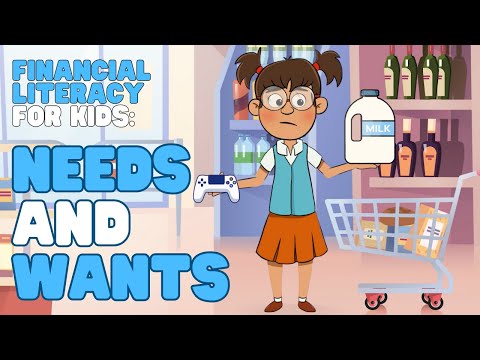
A need is defined as something essential for survival, such as food, water, clothing, and shelter. In contrast, a want is something desirable for enjoyment but not essential for survival, like a skateboard, video game, or a favorite toy. Recognizing this distinction helps in making better financial decisions and prioritizing spending.
Budgeting is a fundamental tool for financial health, preventing overspending and debt.
A budget is a plan that outlines estimated income (money earned or received as a gift) and expenses (money spent). Creating a budget helps individuals live within their means, meaning they spend only the money they have, thus avoiding the accumulation of debt. Debt is defined as money borrowed that must be repaid.
Saving involves setting money aside for the future, while borrowing means taking a loan that must be repaid with interest.
Saving is the act of not spending money immediately but reserving it for future use, often for a specific goal or item, and can be done through methods like piggy banks or savings accounts. Borrowing, or taking a loan, is receiving money with the obligation to pay it back, usually with an additional charge called interest, which is a percentage of the borrowed amount. Savings accounts, kept at banks, allow money to grow over time by earning interest, whereas checking accounts are for immediate transactions and do not earn interest.
Credit cards represent borrowed money with repayment obligations and interest, while debit cards use funds already in a bank account.
A credit card is a tool issued by financial institutions that allows users to borrow money from the issuer to make purchases. This borrowed amount must be repaid on a schedule, typically monthly, with interest charged on any unpaid balance. A debit card, on the other hand, is linked directly to a user's bank account (either savings or checking). When a debit card is used, the money is immediately deducted from the available balance in the account; no borrowing is involved.
Financial literacy helps kids understand how to earn and manage money for desired items.
The video begins by addressing children who might have seen items they want in stores and may have been advised to save money for them. It sets the stage for defining key financial terms to build financial literacy.
Loans often require repayment plus interest, which is an extra charge for borrowing.
Loans are frequently given for specific reasons, like purchasing a large item such as a house or car. Typically, interest must be paid on the loan. Interest is an extra charge, calculated as a percentage of the borrowed amount, that is paid in addition to the full amount borrowed.
Sections
Introduction to Financial Literacy
Financial literacy helps kids understand how to earn and manage money for desired items.
The video begins by addressing children who might have seen items they want in stores and may have been advised to save money for them. It sets the stage for defining key financial terms to build financial literacy.
Frankie Finance character introduced to aid in learning financial concepts.
A character named Frankie Finance is introduced as a helper to explain financial concepts.
Needs vs. Wants
Needs are essential for survival; wants are desirable but not essential.
A need is defined as something one must have to survive, such as food, water, clothing, and shelter. A want is something that would be fun to have but is not necessary for survival, like a skateboard, video game, or favorite toy.
Differentiating needs from wants aids in responsible money management.
Understanding the distinction between needs and wants is presented as a key factor in becoming more responsible with money.
Making a Budget
A budget is a plan for managing money based on income and expenses.
A budget is defined as a plan for managing one's money. It is formulated based on an estimation of income, which includes money earned or received as a gift, and expenses, which is the money spent.
Budgets help individuals live within their means and avoid debt.
One primary purpose of creating a budget is to help individuals live within their means, meaning they do not spend more money than they have. This practice helps in avoiding debt.
Debt is defined as borrowed money that must be repaid.
Debt is explained as money that is borrowed from someone else and has the obligation to be repaid.
Saving Versus Borrowing
Saving is setting money aside for the future, while borrowing is taking a loan.
Saving is described as setting money aside for the future and not spending it immediately, such as saving up for a special toy or activity, often using a piggy bank or a savings account. Borrowing money, also known as taking a loan, means receiving money that is expected to be paid back.
Loans often require repayment plus interest, which is an extra charge for borrowing.
Loans are frequently given for specific reasons, like purchasing a large item such as a house or car. Typically, interest must be paid on the loan. Interest is an extra charge, calculated as a percentage of the borrowed amount, that is paid in addition to the full amount borrowed.
Savings accounts allow money to grow by earning interest.
A savings account is a place to store money intended for saving over a period. Interestingly, money held in a savings account can earn extra money, also called interest. Unlike the interest paid on a loan, this is money earned while the funds are held in the bank.
Checking accounts are for immediate expenses and do not earn interest.
A checking account is another type of bank account used for paying bills, either by writing a check or using a debit card. These accounts do not earn interest.
Credit Versus Debit
Credit cards allow borrowing money from an issuer, which must be repaid with interest.
A credit card is a plastic card issued by a financial institution that allows the user to borrow money from the company. This borrowed money must be repaid according to a schedule, usually with interest charged on any unpaid amount, typically on a monthly basis.
Debit cards use money already available in a bank account.
Debit cards are linked directly to a user's bank account. When a debit card is used for a purchase, the money is immediately deducted from the user's savings or checking account, using funds they already possess. It does not involve borrowing money.
Review and Encouragement
Review quiz reinforces key definitions of savings, checking accounts, and budgeting.
A true/false question and a fill-in-the-blank question test understanding. The true/false question clarifies that savings and checking accounts are different: savings accounts are for long-term saving and earn interest, while checking accounts are for immediate expenses and do not earn interest. The fill-in-the-blank question asks for the definition of a budget as a plan for managing money.
Recap distinguishes needs and wants.
A question reiterates the difference between a need (something necessary for survival) and a want (something fun but not essential).
Learning financial literacy builds good future money habits.
The video concludes by emphasizing the importance of learning financial literacy to create good money habits for the future and encourages viewers to identify one area to work on for improvement.
Further resources available at learnbrite.org.
Viewers are directed to learnbrite.org for thousands of free resources and turnkey solutions for teachers and homeschoolers.
Ask a Question
*Uses 1 Wisdom coin from your coin balance