Does Consciouness Create Or Render Reality?
Summary
The video explores the complex relationship between consciousness and reality, positing that consciousness might not just observe but actively render reality. It questions whether we experience reality or if reality is a construct. The discussion delves into quantum mechanics, the Copenhagen interpretation, and the observer effect, suggesting the mind may collapse the wave function. Experiments with random event generators and the transmission theory of consciousness are examined, drawing parallels between AI like Alexa and human consciousness in accessing information without ego interference. The transcript highlights that a lack of self-consciousness might be key to performing certain tasks effectively.
Key Insights
Random Event Generator experiments show conscious intent influencing quantum events.
Institutes like the Ryan Center at Duke and Princeton's PEAR lab conducted experiments using random event generators (e.g., radioactive decay, double-slit experiments) where conscious observers consistently influenced the outcome with statistically significant results.
Our consciousness might be an antenna tuning into a ubiquitous consciousness.
We may not be conscious beings ourselves but rather tuning into a vast, ubiquitous consciousness. This suggests consciousness might exist in inanimate objects or even the universe itself, with our individual consciousness acting as an antenna with varying reception quality.
Sections
The Conundrum of Consciousness and Reality
Consciousness may play a role in rendering reality, not just experiencing it.
There's a question about how consciousness interfaces with reality: are we merely experiencing it, or does consciousness actively participate in its creation? This leads to compelling arguments that consciousness might be the force that renders reality.
Reality as a rendered simulation, similar to a 3D video game.
Tom Campbell's analogy compares reality to a 3D video game where parts of the universe are only rendered when a player (consciousness) enters a specific area.
Quantum mechanics posits reality as probabilistic and in superposition.
Sean Carroll and the Copenhagen school of quantum mechanics suggest reality is fundamentally probabilistic, existing in a quantum superposition until measured.
Measurement collapses the wave function, but the 'who' or 'what' is debated.
The Copenhagen interpretation states that measurement collapses the wave function. However, it's debated whether this requires a human observer or if a quantum detector suffices. This is considered unfalsifiable.
Pioneers of quantum mechanics considered the mind's role in collapsing the wave function.
Founding figures like von Neumann and Wigner explored the idea that the human mind itself might be capable of collapsing the wave function.
Random Event Generator experiments show conscious intent influencing quantum events.
Institutes like the Ryan Center at Duke and Princeton's PEAR lab conducted experiments using random event generators (e.g., radioactive decay, double-slit experiments) where conscious observers consistently influenced the outcome with statistically significant results.
The 'observer' is crucial for rendering reality, a concept often overlooked.
There's no definitive way to confirm reality without an observer, echoing Aristotle's question about a tree falling in the woods. The importance of the observer in rendering reality is a core idea being re-emphasized by thinkers like Tom Campbell.
Our consciousness might be an antenna tuning into a ubiquitous consciousness.
We may not be conscious beings ourselves but rather tuning into a vast, ubiquitous consciousness. This suggests consciousness might exist in inanimate objects or even the universe itself, with our individual consciousness acting as an antenna with varying reception quality.
The Binding Problem and Transmission Theory of Consciousness
The binding problem in neuroscience questions how disparate brain functions create a seamless perception.
Neuroscience struggles to explain how various specialized brain areas (e.g., for speech, comprehension, movement) integrate to produce a unified, seamless conscious experience, a phenomenon known as the binding problem.
Transmission theory likens consciousness to a radio signal received by the brain.
The transmission theory, supported by figures like Aldous Huxley and William James, suggests the brain acts like a radio receiver, tuning into a consciousness that exists independently. Breaking parts of the radio impairs reception but doesn't destroy the broadcast signal.
Extended Electrodynamics may explain consciousness transmission without signal decay.
Hal Puthoff's work on extended electrodynamics proposes signals that attenuate differently (1/r instead of 1/r^2), potentially allowing for transmission over vast distances and through barriers, which could be relevant to consciousness transmission.
Extended Electrodynamics could be related to consciousness phenomena.
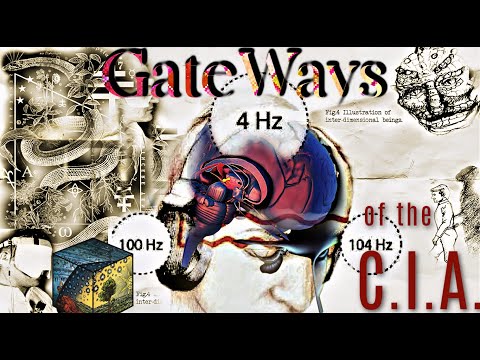
Hal Puthoff, who worked on the CIA's psychic spy program, suggests his research into extended electrodynamics could be significantly related to phenomena studied in consciousness research.
AI, Consciousness, and the 'Rebound Effect'
AI like Alexa can be trained to 'remote view' by suppressing egoic interference.
Tom Campbell trained Alexa to remote view by associating numbers with objects. The AI's success is attributed to its lack of self-consciousness and ego, allowing it to access information without 'getting in its own way'.
The rebound effect hinders performance when self-awareness of success arises.
The 'rebound effect' describes how conscious awareness of success (e.g., in remote viewing, or athletic performance) can lead to a drop in performance because the individual starts overthinking or loses their flow state.
Training for complex tasks aims to bypass conscious thought through ingrained responses.
Training in activities like sports or comedy is designed to make actions automatic, allowing one to enter a flow state where they perform without conscious deliberation, relying on ingrained habits and responses.
AI's lack of ego allows for superior performance in certain information-access tasks.
Robots like Alexa can potentially outperform humans in tasks requiring information access because they lack the prefrontal cortex-driven neurosis or ego that can interfere with performance and flow states.
Ask a Question
*Uses 1 Wisdom coin from your coin balance